May 4, 2026 · 12 min read
Are My Eyes Hazel or Brown? How to Tell the Difference
Learn the exact visual cues and genetic differences between hazel or brown eyes. Discover how melanin and light scattering determine your true eye color.
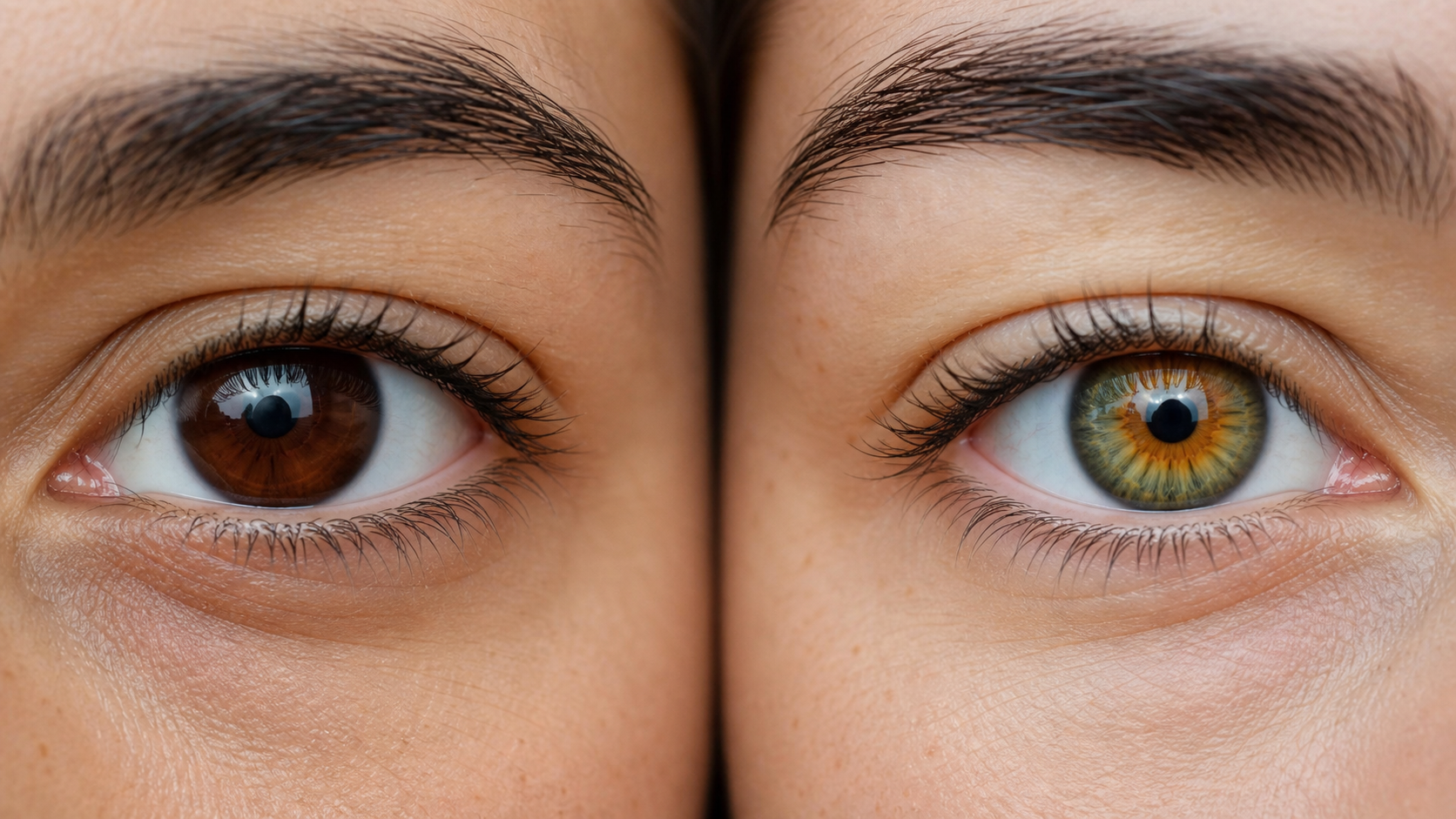
The main difference between hazel or brown eyes is the distribution of color across the iris. Brown eyes feature a solid, uniform layer of melanin that covers the entire iris, absorbing light to create a consistent dark shade. Hazel eyes contain multiple distinct colors, usually an inner ring of brown or gold surrounded by an outer ring of green. If your iris is a single solid shade of light or dark brown, you have brown eyes. If you see concentric rings or bursts of different colors blending together, you have hazel eyes.
What is the genetic difference between hazel or brown eyes?
The genetics of eye color are complex and involve multiple genes interacting with each other. Scientists previously believed that eye color followed a simple Mendelian inheritance pattern, where brown was dominant and blue was recessive. Modern genetic research shows that up to 16 different genes influence eye color. The most important genes in determining whether you have hazel or brown eyes are OCA2 and HERC2.
The role of OCA2 and HERC2
The OCA2 gene produces a protein called P protein. This protein is essential for the maturation of melanosomes, which are the cellular structures that produce and store melanin pigment. The HERC2 gene regulates the OCA2 gene. A specific region within the HERC2 gene acts as an enhancer for OCA2 expression.
If this enhancer is highly active, your body produces a large amount of P protein. This leads to a high concentration of melanin in the stroma, the front layer of the iris. High melanin concentration results in solid brown eyes. If the enhancer has a mutation that reduces its activity, OCA2 expression drops. This results in less melanin production. Moderate melanin levels combined with specific distribution patterns result in hazel eyes.
Additional genetic modifiers
Beyond OCA2 and HERC2, other genes fine-tune the exact shade and pattern of your eyes. The TYR gene provides instructions for making an enzyme called tyrosinase. Tyrosinase is required for the first step of melanin production. Variations in the TYR gene affect how much pigment is ultimately created. The SLC24A4 gene helps regulate calcium in cells, which also influences pigmentation levels. The complex interaction of these genes determines whether melanin is deposited evenly across the iris, creating brown eyes, or irregularly, creating the multicolored appearance of hazel eyes.
How can you tell if your eyes are hazel or brown?
Examining your eyes in the right conditions is crucial for accurate identification. Many people mistake light brown eyes for hazel eyes because they do not look closely at the texture and color distribution of the iris.
Here are the exact steps to determine your eye color:
- Find a source of indirect natural sunlight. Direct sunlight causes you to squint and creates harsh shadows. Artificial indoor lighting often casts a yellow or blue tint that alters the appearance of your eyes.
- Stand facing the light source and hold a mirror a few inches from your face.
- Examine the pupil border. Look at the area immediately surrounding the black center of your eye.
- Check the outer edge. Look at the perimeter of the iris where it meets the white of the eye.
- Look for color transitions. Identify whether the color is the same near the pupil as it is near the outer edge.
If the color remains a consistent shade of brown from the pupil to the outer edge, you have brown eyes. If you see a distinct shift from brown near the pupil to green or gray near the outer edge, you have hazel eyes. Hazel eyes often feature a starburst or sunburst pattern radiating outward from the pupil.
Are light brown eyes the same as hazel eyes?
Light brown eyes are frequently confused with hazel eyes, but they are not the same. The confusion stems from the fact that both eye colors contain a significant amount of brown pigment. The distinction relies entirely on uniformity.
The anatomy of light brown eyes
Light brown eyes contain less melanin than dark brown eyes, but the melanin is distributed evenly throughout the stroma. When light enters a light brown eye, the even layer of melanin absorbs the light uniformly. This creates a solid, consistent color. Sometimes light brown eyes are referred to as amber eyes if they have a strong golden or copper tint. However, true amber eyes are solid and uniform. Amber eyes are rare, representing about 5% of the global population. If your eyes are a solid, golden-brown color without any green or gray zones, they are classified as brown eyes.
The anatomy of hazel eyes
Hazel eyes are defined by their lack of uniformity. They are characterized by a phenomenon called central heterochromia. Central heterochromia occurs when the center of the iris is a different color than the outer ring. In hazel eyes, the inner ring is typically brown or gold, while the outer ring is green. The boundary between the two colors is not a sharp line. The colors blend into each other, creating a mottled or speckled appearance. This uneven distribution of melanin is the defining characteristic of hazel eyes.
What role does lighting play in eye color?
Lighting completely changes how we perceive eye color. This is especially true for hazel eyes. Hazel eyes are highly responsive to different lighting environments due to the way light interacts with the physical structure of the iris.
The Tyndall effect and Rayleigh scattering
The stroma of the iris does not contain any blue or green pigment. The only pigment present in the human eye is melanin, which is naturally dark brown or black. The appearance of green or blue in the eye is caused by structural coloration.
When light hits an eye with low or moderate melanin, some of the light passes through the stroma and reflects off the dark back layer of the iris. As the light travels back through the stroma, it scatters. Short wavelengths of light, like blue, scatter much more easily than long wavelengths, like red. This scattering of light in a turbid medium is similar to the Tyndall effect.
> The Tyndall effect is the scattering of light by particles in a colloid or in a very fine suspension. In hazel eyes, the scattered blue light mixes with the brown and yellow melanin in the stroma to produce the perception of green.
Why hazel eyes appear to change color
Because hazel eyes rely on scattered light to create their green hues, the quality of the light source drastically affects their appearance. In bright, cool-toned daylight, the blue light scattering is maximized. This makes the green portions of a hazel eye appear vibrant and dominant. In dim or warm-toned indoor lighting, less blue light is available to scatter. The brown melanin absorbs the available light, making the eye look solid brown. This optical illusion is why people with hazel eyes often feel their eye color changes day to day.
Brown eyes are less affected by lighting changes. Because the stroma is densely packed with melanin, almost all light is absorbed regardless of the environment. Brown eyes will simply look darker in dim light and lighter in bright light, but they will not change hue.
How rare are hazel eyes compared to brown eyes?
When comparing hazel or brown eyes, there is a massive difference in global prevalence. Brown is the most common eye color in the world by a significant margin.
- Brown eyes: Approximately 79% of the global population has brown eyes.
- Blue eyes: Approximately 8% to 10% of the population has blue eyes.
- Hazel eyes: Approximately 5% of the population has hazel eyes.
- Amber eyes: Approximately 5% of the population has amber eyes.
- Green eyes: Approximately 2% of the population has green eyes.
- Gray eyes: Approximately 1% of the population has gray eyes.
Geographic distribution of brown eyes
Brown eyes are dominant across most continents. They are the most common eye color in Africa, Asia, and South America. In many of these regions, brown eyes account for over 90% of the population. High levels of melanin provided an evolutionary advantage in ancient human populations living near the equator. Melanin protects the inner structures of the eye, particularly the retina, from damaging ultraviolet radiation from the sun.
Geographic distribution of hazel eyes
Hazel eyes are most commonly found in populations of European descent. They are particularly prevalent in regions where different distinct populations have historically mixed. Hazel eyes are frequently seen in people from the United Kingdom, Spain, France, and parts of the Middle East and North Africa. The combination of genetic traits required to produce moderate, uneven melanin distribution makes hazel eyes relatively rare on a global scale.
Can hazel or brown eyes change over time?
Many people wonder if their brown eyes can turn hazel, or if their hazel eyes can turn solid brown. While your genetic eye color is set before birth, the actual appearance of your eyes can shift during certain life stages.
Infant eye color changes
Most babies born to parents of European descent are born with blue or slate gray eyes. This happens because the melanocytes, the cells responsible for producing melanin, are not fully active at birth. Over the first year of life, exposure to light stimulates the melanocytes to begin producing melanin. As melanin accumulates in the stroma, the eyes gradually darken. A baby born with blue eyes might develop hazel or brown eyes by their first birthday. Eye color is usually stable by age three. Babies born to parents of African or Asian descent are typically born with brown eyes that remain brown throughout their lives.
Aging and eye color
In some adults, eye color can subtly change due to the aging process. The pigment in the iris can slowly degrade over decades. This loss of pigment can cause dark brown eyes to become slightly lighter or more translucent. For people with hazel eyes, the degradation of melanin can cause the brown and gold areas to fade, making the green portions more prominent. Alternatively, some people develop a condition called arcus senilis as they age. This creates a gray or white ring around the outer edge of the cornea. While this does not change the iris pigment, it alters the overall appearance of the eye.
Pupillary dilation and perceived color
The size of your pupil directly impacts the appearance of your iris. The pupil is the black hole in the center of the eye that lets light in. When you are in a dark room, your pupil dilates to let in more light. When the pupil dilates, the iris tissue is compressed and pushed outward. This compression forces the pigment granules closer together. For someone with hazel eyes, pupil dilation can hide the inner brown ring and emphasize the outer green ring. When you step into bright light, the pupil constricts. The iris tissue unrolls and spreads out. This reveals the full pattern of colors in a hazel eye.
Do surrounding colors influence hazel or brown eyes?
The perception of eye color is heavily influenced by the colors immediately surrounding the eye. This is known as simultaneous contrast. The brain processes color based on context.
The impact of clothing and makeup
Clothing and makeup can significantly alter the appearance of hazel eyes. Because hazel eyes contain a mix of colors, certain surrounding shades can draw out specific hues in the iris.
- Wearing green or olive: This enhances the green outer ring of hazel eyes, making them look predominantly green. This is a helpful tip when comparing hazel versus green eyes.
- Wearing brown or gold: Earth tones pull focus to the central brown ring, making hazel eyes appear much closer to solid brown.
- Wearing purple or plum: Purple is opposite to yellow and green on the color wheel. Purple eyeshadow or clothing creates high contrast, making the gold and green flecks in hazel eyes pop brightly.
- Wearing black or dark blue: Dark, neutral colors tend to make brown eyes look richer and deeper.
Because solid brown eyes do not contain multiple competing colors, they are less affected by simultaneous contrast. Brown eyes will maintain their solid hue regardless of the clothing worn, though warm tones like gold and bronze can complement them well.
Eumelanin and pheomelanin in the iris
To truly understand the difference between hazel or brown eyes, it helps to look at the specific types of melanin present in the human body. There are two primary types of melanin that influence human pigmentation: eumelanin and pheomelanin.
Eumelanin
Eumelanin is the most abundant type of melanin. It comes in two varieties: black and brown. Eumelanin is highly effective at absorbing light and provides excellent protection against UV radiation. People with solid, dark brown eyes have a very high concentration of brown and black eumelanin densely packed into the stroma of the iris. The sheer volume of eumelanin prevents any light scattering from occurring.
Pheomelanin
Pheomelanin is a different type of pigment that produces reddish, yellow, and copper hues. It is the same pigment responsible for red hair and freckles. While eumelanin dominates in brown eyes, hazel eyes often contain a mix of moderate eumelanin and significant pheomelanin. The pheomelanin creates the amber, gold, and yellow flecks commonly seen near the pupil in hazel eyes. The combination of yellow pheomelanin and blue scattered light creates the distinct olive green shades characteristic of hazel eyes.
Why guessing your eye color is difficult
Determining whether you have hazel or brown eyes visually can be frustrating. The human eye struggles to isolate small details when assessing its own reflection in a mirror. Factors like room lighting, monitor color calibration, and even the time of day can alter your perception.
Many people spend years believing they have brown eyes, only to discover later in life that they actually have hazel eyes with a dominant central brown ring. Conversely, some people assume they have hazel eyes because they see reflections of the sky or room lights in their solid light brown irises.
Getting an objective answer requires isolating the iris from environmental lighting biases and analyzing the pixel data directly.
How the Eye Color Identifier helps
If you are tired of guessing and want a definitive answer, you can use the free eye color identifier to analyze your iris. The Eye Color Identifier removes the guesswork from determining if you have hazel or brown eyes.
Instead of relying on subjective mirror checks, the tool uses advanced computer vision to analyze a photo of your eye. When you upload an image, the system scans the pixel data to map the exact distribution of pigment across your iris. It detects the presence of central heterochromia, measures the concentration of brown versus green pixels, and evaluates the uniformity of the stroma. This allows the tool to accurately classify whether your eye is a solid shade of light brown or a true multicolored hazel.
The process is fast, free, and completely private. All image analysis is processed server-side by a secure vision AI provider. The system requires zero data retention. Your photos are analyzed in real-time and are never saved, stored, or shared. You get instant, factual results about your unique eye color without compromising your digital privacy.
Frequently asked questions
Are hazel eyes just a type of brown eye?
No, hazel eyes are a distinct eye color category. While they do contain brown pigment, their defining feature is the presence of multiple colors, usually brown, green, and gold. Brown eyes have a uniform distribution of melanin, whereas hazel eyes have an irregular distribution that allows light to scatter and produce green hues.
Can two brown-eyed parents have a hazel-eyed child?
Yes, two parents with brown eyes can have a child with hazel eyes. Eye color is a polygenic trait involving many genes. Both parents can carry recessive genes for lighter eye colors. If both parents pass on mutations that lower melanin production, the child can be born with hazel, green, or even blue eyes.
How can I make my brown eyes look hazel?
You cannot permanently change brown eyes to hazel naturally. However, you can use makeup to create optical illusions. Using green, purple, or gold eyeshadow can highlight any subtle lighter undertones in brown eyes. Wearing olive green clothing can also cast reflections that make light brown eyes appear slightly more hazel in bright sunlight.
What is the difference between hazel eyes and central heterochromia?
Hazel is a specific eye color characterized by a mix of green, brown, and gold. Central heterochromia is the physical pattern where the inner ring of the iris is a different color than the outer ring. Hazel eyes almost always feature central heterochromia. However, you can have central heterochromia with other colors, such as a blue eye with a yellow center.
Do hazel eyes get darker with age?
Hazel eyes generally do not get darker with age. If anything, eye color tends to fade or lighten slightly as people enter their senior years due to the slow degradation of melanin pigment. Any sudden darkening of the eye in adulthood should be evaluated by an eye doctor, as it could indicate a medical condition.
Is hazel dominant over green?
In the traditional model of eye color genetics, hazel is considered dominant over green and blue, but recessive to brown. Because hazel eyes require more melanin than green eyes, the genetic instructions to produce that extra melanin typically override the instructions for lower melanin. However, modern genetics show that inheritance is much more complex than simple dominance.
Identify your eye color now
Stop relying on bathroom mirrors and confusing lighting to figure out your eye color. Get a factual, objective analysis based on the exact pigment distribution in your iris. Identify your eye color securely today and finally know for sure whether your eyes are hazel, brown, or something entirely unique.
Try the Eye Color Identifier
Find your eye color in seconds. Your data is kept secure — we don't store your data.
More articles
Rare Eye Color Combinations: Heterochromia and More
Rare eye color combinations include heterochromia, central rings, and sectoral patterns. Learn how they form and how to classify them clearly.
Do Eyes Change Color? Babies, Light, and Real Changes
Do eyes change color? Learn when shifts are normal in babies, why hazel and lighting can mislead, and when eye color changes merit a check.
Eye Color Identifier: What Eye Color Am I, Really?
Eye color identifier guide: learn how AI answers “What eye color am I?”, why eyes get mislabeled, and what genetics can and cannot tell you.