May 4, 2026 · 12 min read
Gray vs Blue Eyes: How to Tell the Difference Scientifically
Learn the scientific difference in the gray vs blue eyes debate. Discover how collagen density, genetics, and lighting affect eye color identification.
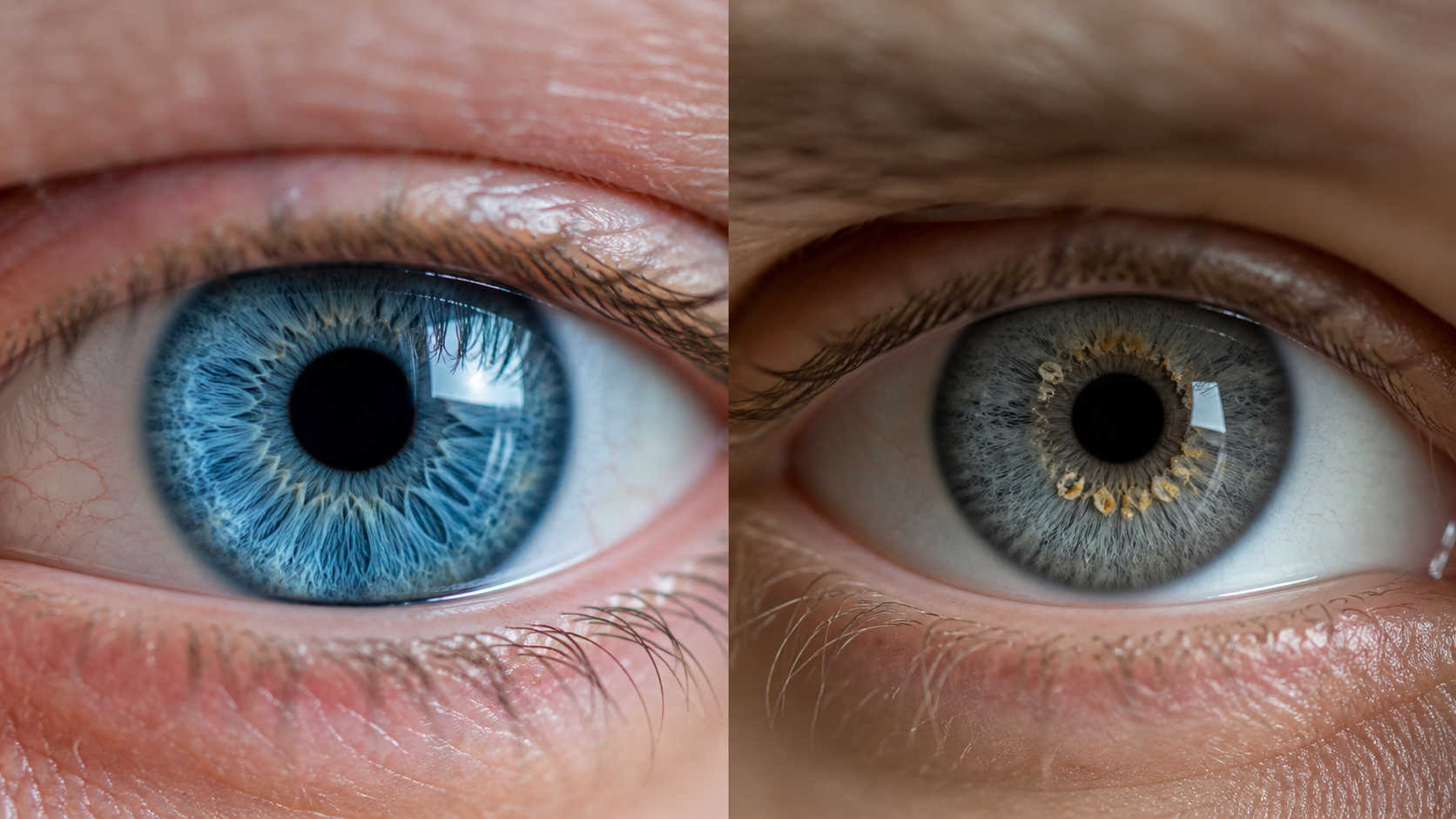
The primary difference in the gray vs blue eyes debate lies in the concentration of collagen and the specific type of light scattering that occurs within the iris. Blue eyes rely entirely on the Tyndall effect to scatter short blue wavelengths of light through a perfectly clear stroma. Gray eyes contain larger collagen deposits that trigger Mie scattering instead. This physical structural difference causes gray eyes to reflect a wider spectrum of light evenly, resulting in a cloudy or metallic appearance rather than a pure blue hue. Understanding these distinct optical mechanisms makes it easier to accurately classify your eye color.
What is the main structural difference between gray and blue eyes?
The human iris consists of two primary layers. The back layer is called the pigment epithelium. The front layer is called the stroma. In both blue and gray eyes, the back pigment epithelium contains high amounts of melanin, which absorbs stray light. The visual difference between the two colors originates entirely within the front stroma layer.
The stroma is a complex meshwork of cells. It contains fibroblasts, blood vessels, melanocytes, and collagen fibers. In blue eyes, this stroma is almost completely devoid of melanin and has very thin, sparse collagen fibers. This creates a highly translucent medium. Light enters this clear stroma, hits the microscopic particles, and scatters back outward.
The unique structure of gray eyes presents a different physical makeup. While gray eyes also have zero to minimal melanin in the stroma, they possess a significantly higher density of extracellular matrix components. Specifically, they contain much larger and thicker deposits of collagen. This thicker, more densely packed collagen mesh changes the physical properties of the iris. When light enters a gray iris, it encounters these large collagen obstacles. The light cannot pass through cleanly, nor can it scatter in the same highly selective way it does in a blue eye. This anatomical variation in the stroma is the fundamental reason gray and blue eyes look different to the human eye.
How does light scattering create the illusion of blue eyes?
Blue eyes do not contain any blue pigment. The color is purely a structural phenomenon created by the interaction of light with the clear stroma. This process relies on a physics principle known as the Tyndall effect. The Tyndall effect is very similar to Rayleigh scattering, which is the optical phenomenon that makes the sky appear blue.
Visible light travels in waves. Different colors of light have different wavelengths, measured in nanometers. Red light has a long wavelength of about 700 nanometers. Blue light has a short wavelength of about 400 to 450 nanometers. When white light, which contains all visible colors, enters the clear stroma of a blue eye, the longer wavelengths pass straight through the tissue. These red, orange, and yellow wavelengths travel to the back of the iris and are completely absorbed by the dark pigment epithelium.
However, the shorter blue wavelengths cannot pass easily through the microscopic particles suspended in the stroma. Instead of passing through, the blue light waves collide with these tiny particles and bounce back outward toward the viewer. Because only the blue light reflects outward, the eye appears blue. This makes blue eyes a brilliant optical illusion. The purity and brightness of the blue depend directly on just how empty and clear the stroma is. Any extra proteins, collagen, or trace pigments will disrupt the Tyndall effect and alter the resulting color.
Why do gray eyes reflect light differently than blue eyes?
Gray eyes operate on a different optical principle called Mie scattering. Gustav Mie originally described this physical phenomenon to explain how light interacts with particles that are relatively large compared to the wavelength of the light itself. While the Tyndall effect relies on tiny microscopic particles, Mie scattering occurs when light hits larger obstacles.
In gray eyes, the larger obstacles are the thick collagen bundles packed into the stroma. These collagen deposits are much larger than the particles found in blue eyes. When incoming white light hits these large collagen bundles, the light does not split based on wavelength. The collagen is too large to selectively scatter only the short blue waves. Instead, the large particles scatter all wavelengths of light equally. Red, green, and blue light waves are all scattered back outward at the same time.
When all colors of the visual spectrum are reflected equally and mixed back together, the result is white light. Because this reflected white light sits against the dark background of the pigment epithelium, it appears to the human eye as a desaturated gray, silver, or cloudy color.
> "The visual distinction between gray and blue eyes is not a matter of pigment, but rather the physical size of collagen deposits in the stroma dictating how white light fragments and reflects."
This is the exact same optical mechanism that dictates the color of the sky versus the color of clouds. The clear atmosphere relies on Rayleigh scattering to look blue. Heavy rain clouds rely on Mie scattering from large water droplets to look gray. Gray eyes are essentially blue eyes with built-in cloud cover.
How rare are gray eyes compared to blue eyes?
Understanding the rarity of these eye colors requires looking at global population statistics. Human eye color is distributed highly unevenly across the globe. Brown is the dominant eye color, accounting for approximately 79 percent of the global population. Blue eyes are the second most common color, making up about 8 percent of the world.
Gray eyes are exceptionally rare. They account for only about 1 percent of the global population. This extreme rarity makes gray one of the least common eye colors on the planet, often tied with or slightly behind pure green eyes, which account for about 2 percent. The rarity scale highlights exactly how unusual the structural collagen density of a gray eye truly is.
Geographic distribution also plays a major role in how these colors manifest in populations. Blue eyes are most heavily concentrated in Northern Europe, particularly around the Baltic Sea. Countries like Finland and Estonia boast populations where the vast majority of people have blue eyes. This trait traces back to a specific genetic mutation that occurred near the Black Sea regions thousands of years ago.
Gray eyes have a slightly different geographic footprint. They are most commonly found in Eastern Europe, particularly in Russia, Ukraine, and Poland, as well as in parts of Central Asia and the Middle East. Due to historical migration patterns, the genetic markers for both eye colors often overlap, which is why they frequently appear in the same family lineages. Despite this overlap, gray remains statistically far rarer than blue.
How do genetics determine if you have gray or blue eyes?
Eye color is a polygenic trait. This means it is controlled by the complex interaction of multiple genes, rather than a single dominant or recessive gene as once thought. The outdated Punnett square model taught in schools cannot accurately explain the subtle differences between gray and blue eyes.
The two most important genes for determining basic eye color are OCA2 and HERC2. Both of these genes are located closely together on chromosome 15. The OCA2 gene provides instructions for making a protein known as the P protein, which is essential for the production and transport of melanin. The HERC2 gene acts as a switch that controls the OCA2 gene.
For someone to have blue or gray eyes, they must inherit a specific variation of the HERC2 gene that effectively turns off the OCA2 gene in the iris. This halts melanin production in the front layer of the eye. However, this alone only creates a lack of pigment. It does not dictate whether the stroma will be clear or dense with collagen.
To understand the distinction in our blue vs gray eyes analysis, we must look at secondary genes. Genes such as SLC24A4, TYR, and TYRP1 heavily influence the fine details of the iris structure. The SLC24A4 gene is particularly associated with variations in light eye colors. These secondary genetic modifiers dictate the structural density of the stroma, determining how thick the collagen bundles will grow during early childhood development. This complex genetic lottery determines if a person will develop the clear stroma necessary for blue eyes or the cloudy, dense stroma necessary for gray eyes.
Can lighting change whether eyes look gray or blue?
Gray eyes are famous for their chameleonic ability to appear different colors in different environments. This is a direct result of their reliance on Mie scattering. Because gray eyes reflect all ambient light equally, their apparent color is highly dependent on the light source illuminating them. Blue eyes, which selectively scatter blue light, are much more stable and consistently look blue regardless of the environment.
Ambient color temperature plays a massive role in eye color perception. Color temperature is measured in Kelvin. Natural daylight on a clear afternoon sits around 5500K and emits a very cool, blue-tinted light. When this cool light enters a gray eye, the eye reflects that cool tone back, often making the gray eye appear blue. In contrast, indoor tungsten lighting sits around 3200K and emits a warm, orange or yellow light. When this warm light hits a gray eye, it can make the eye appear metallic, silvery, or even slightly green.
Pupil dilation also alters the physical appearance of the iris. When you enter a dark room, your pupil dilates to let in more light. As the pupil expands, the iris tissue compresses and bunches together. This physical compression increases the density of the collagen fibers in the stroma. This increased density changes how light scatters through the tissue, often making gray eyes look darker or more intensely metallic in low light conditions. When the pupil constricts in bright light, the iris stretches out, spreading the collagen fibers and often making the eye appear lighter and closer to blue.
Clothing and makeup provide additional visual context that tricks the human brain. The brain constantly adjusts color perception based on surrounding colors through a process called simultaneous contrast. If a person with gray eyes wears a bright blue shirt, the color reflects physically onto the glossy surface of the cornea. Additionally, the brain processes the gray eye next to the blue fabric and attempts to harmonize the colors, often causing the observer to perceive the gray eye as blue.
What features help distinguish gray eyes in photos?
Accurately identifying the difference between gray and blue eyes in a photograph can be difficult due to digital processing. Smartphone cameras often apply automatic saturation enhancements, artificially boosting the intensity of muted colors. This digital interference frequently causes gray eyes to look bright blue on a screen.
To combat this digital bias and accurately identify your eye color from a photograph, you need to look for specific anatomical markers within the iris. A pure blue eye will present a uniform, saturated color from the pupil out to the edge. A gray eye will almost always present complex variations.
Follow this checklist when analyzing a macro photograph of an eye: 1. Look for a collarette. The collarette is the inner ring of the iris immediately surrounding the pupil. Gray eyes frequently feature a distinct, jagged inner ring that is a different color than the rest of the eye, often pale yellow or light brown. 2. Search for central heterochromia. Gray eyes are highly prone to mild central heterochromia, where a secondary color blooms outward from the pupil. 3. Check for structural flecks. Pure blue eyes are generally clear and uniform. Gray eyes often contain tiny, isolated flecks of gold, copper, or brown scattered throughout the stroma. 4. Analyze the base saturation. Use a digital color picker tool on the photograph. Blue eyes will register high saturation levels in the blue channel. Gray eyes will register low saturation across all color channels, sitting much closer to a true neutral gray hex code. 5. Examine the limbal ring. The limbal ring is the dark border at the outer edge of the iris. Gray eyes often have a highly defined, thick, dark blue or charcoal limbal ring that contrasts sharply with the pale interior.
How do pigment types affect the visual difference?
While we have established that the main difference between blue and gray eyes is structural, trace amounts of pigment also play a subtle role. The human body produces two main types of melanin pigment. Eumelanin is a dark pigment that ranges from brown to black. Pheomelanin is a lighter pigment that ranges from red to yellow.
The specific ratio and distribution of these two pigments within the stroma dictate the final hue of all eye colors. Pure blue eyes have virtually zero eumelanin and zero pheomelanin in the front layer. They rely entirely on structural scattering. Gray eyes, however, often contain microscopic amounts of pigment that alter their appearance.
- High concentrations of eumelanin create dark brown eyes, blocking all light scattering.
- Moderate concentrations of eumelanin create light brown or hazel eyes.
- Low concentrations of eumelanin mixed with yellow pheomelanin create green eyes.
- Zero melanin in a clear stroma creates pure blue eyes.
- Zero to trace amounts of melanin in a collagen-dense stroma create gray eyes.
When a gray eye contains trace amounts of yellow pheomelanin, that yellow pigment mixes visually with the scattered white light. This subtle combination is what gives many gray eyes their metallic, warm, or slightly greenish tint under certain lighting conditions. The presence of these trace pigments, combined with the dense collagen structure, confirms why gray is treated as a distinct color family rather than just a shade of blue.
How the Eye Color Identifier helps
Determining whether you have gray or blue eyes using a mirror can be incredibly frustrating. The ambient lighting in your bathroom, the color of your walls, and even the time of day can alter your perception. Our subjective human brains are easily tricked by color context and bias. The free eye color identifier removes this subjective guesswork entirely by using advanced vision AI.
When you upload a photo, the AI isolates the specific pixels of your iris, ignoring the surrounding skin tone and lighting biases. It measures the exact hex codes, saturation levels, and structural patterns within the stroma. By comparing these data points against thousands of confirmed anatomical examples, the system can accurately classify whether your eyes exhibit the clear structural scattering of blue eyes or the dense collagen patterns of gray eyes.
The tool operates entirely on server-side vision AI infrastructure. This means your data is processed securely and instantaneously without any photos being stored or saved. This secure analysis provides a definitive, scientific answer to the gray vs blue eyes debate for your unique genetics.
Frequently asked questions
Are gray eyes just dark blue eyes?
Gray eyes are not simply dark blue eyes. They are anatomically distinct due to the presence of heavy collagen deposits in the stroma. Dark blue eyes get their color from a very clear stroma heavily scattering blue light, whereas gray eyes rely on Mie scattering from large structural particles to reflect white and gray light.
Can gray eyes turn blue over time?
Eye color generally stabilizes by early childhood and does not permanently change from gray to blue. However, gray eyes can temporarily appear blue due to changes in lighting, pupil dilation, or the colors you are wearing. Aging can sometimes cause the iris pigment to fade slightly, but the structural collagen density remains constant.
What color do gray eyes look like in the dark?
In very low light, the pupils dilate heavily, compressing the iris tissue. This compression forces the collagen fibers closer together, which alters the scattering of light. Because of this structural change and the lack of ambient light, gray eyes often appear completely black, deep charcoal, or very dark silver in the dark.
Is gray the rarest eye color?
Gray is considered one of the rarest eye colors globally, accounting for approximately 1 percent of the population. Depending on specific demographic measurements, it is often tied with or slightly rarer than pure green eyes. It is significantly rarer than blue eyes, which make up about 8 percent of the global population.
Do gray eyes have any melanin?
Gray eyes have a high amount of melanin in the back layer of the iris, called the pigment epithelium, just like all other eye colors. However, the front layer, the stroma, contains virtually zero melanin. Some gray eyes may have trace amounts of yellow pheomelanin, which creates the tiny gold or brown flecks often seen near the pupil.
Identify your eye color now
Stop guessing whether your eyes are true blue or metallic gray. Our secure, AI-powered analysis tool evaluates the unique structural patterns and pigment distribution in your iris to give you a definitive scientific answer. Identify your eye color today and discover the exact genetic and structural makeup of your eyes.
Try the Eye Color Identifier
Find your eye color in seconds. Your data is kept secure — we don't store your data.
More articles
Rare Eye Color Combinations: Heterochromia and More
Rare eye color combinations include heterochromia, central rings, and sectoral patterns. Learn how they form and how to classify them clearly.
Do Eyes Change Color? Babies, Light, and Real Changes
Do eyes change color? Learn when shifts are normal in babies, why hazel and lighting can mislead, and when eye color changes merit a check.
Eye Color Identifier: What Eye Color Am I, Really?
Eye color identifier guide: learn how AI answers “What eye color am I?”, why eyes get mislabeled, and what genetics can and cannot tell you.