May 12, 2026 · 12 min read
Brown vs Hazel Eyes: The Science Behind Multi-Toned Irises
Learn the exact differences in the brown vs hazel eyes debate. Discover how melanin distribution, light scattering, and genetics determine your true eye color.
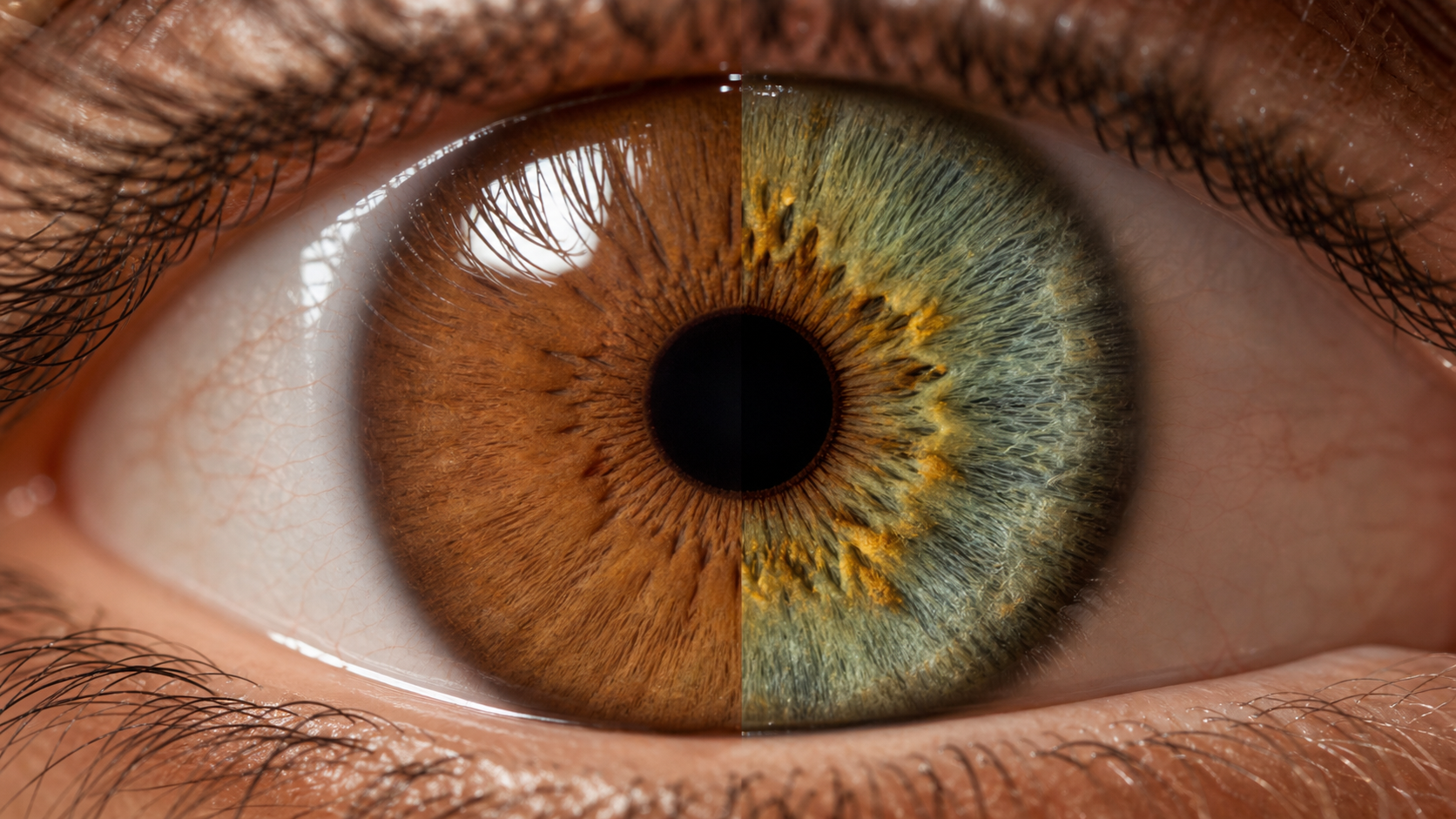
The main difference in the brown vs hazel eyes debate comes down to how pigment is distributed across the iris. Brown eyes have a solid, uniform layer of melanin that covers the entire surface, whereas hazel eyes feature a multi-toned blend of brown, green, and sometimes gold. This uneven pigmentation in hazel eyes allows light to scatter within the cellular structure, creating a distinct color-shifting effect that solid brown eyes do not exhibit.
What is the core difference between brown vs hazel eyes?
The fundamental distinction between these two eye colors lies in the physical structure of the iris. Every human eye features a back layer called the pigment epithelium. This layer contains dense brown pigment regardless of the visible eye color you see in the mirror. The true determinant of brown versus hazel rests entirely in the anterior border layer and the stroma.
The uniform pigmentation of brown eyes
The stroma is the middle tissue of the iris. In solid brown eyes, this stroma is heavily packed with melanin. This dark pigment absorbs almost all the visible light that enters the eye. The dense absorption prevents light from bouncing back out, giving the eye a rich, uniform color. The color remains stable regardless of the environment. For more details on the most common eye color, you can read our guide to brown eyes.
The multi-toned complexity of hazel eyes
In hazel eyes, the stroma contains significantly less melanin. More importantly, the pigment is unevenly distributed. The color typically concentrates in a ring around the pupil, leaving the outer edges of the iris with sparse pigmentation. This structural variety allows different parts of the iris to reflect light differently, creating a dynamic mix of shades within a single eye. To understand the specific traits of the multi-toned iris, check out our guide to hazel eyes.
Why do families confuse light brown eyes with hazel?
Many people grow up believing they have hazel eyes simply because their brown eyes look lighter in direct sunlight. Families often pass down the hazel label incorrectly because they do not realize that true hazel is defined by multiple colors in one iris, not just a lighter shade of brown. For a broader overview of the basic differences, you can review our previous analysis on how to tell if your eyes are hazel or brown.
The honey-brown illusion
Light brown eyes, often described as honey or amber-brown, possess a lower overall concentration of melanin than dark brown eyes. However, they lack the structural variety required to be classified as hazel. Hazel eyes must contain distinct zones of different colors, typically a brown ring near the pupil and a green or gray outer edge. When bright light hits a light brown iris, the uniform melanin simply reflects a brighter golden hue. This is a change in brightness, not a true multi-color composition.
Conditions that cause misidentification
Here are the most common reasons light brown eyes are mistakenly identified as hazel: * The presence of a strong golden undertone that flares up in bright sunlight. * Wearing green or earthy clothing colors that contrast with the brown iris. * Camera flashes washing out the uniform pigment, making it look artificially fragmented. * A lack of understanding that true hazel requires a distinct green or gray component. * Confusion between amber eyes, which are solid copper or gold, and hazel eyes.
The anatomy of the iris in brown and hazel eyes
To accurately determine your eye color, you must look closely at the distinct zones of your iris. The structure of the iris dictates how we perceive its color.
The pupillary zone
The pupillary zone is the area immediately surrounding the pupil. In both brown and hazel eyes, this area often contains the heaviest concentration of melanin. In hazel eyes, this central ring is usually dark brown, gold, or rust-colored. The sharp contrast between this dark center and the rest of the eye is a hallmark of the hazel family.
The ciliary zone
The ciliary zone is the larger outer area of the iris that stretches toward the white of the eye. In brown eyes, the color of the ciliary zone perfectly matches the color of the pupillary zone. In hazel eyes, the ciliary zone drastically shifts in color. It typically transitions into a murky green, a muted gray, or a vibrant olive tone.
How to examine your iris for multi-toned pigment
You can perform a visual check to determine your precise color composition. Follow these steps to examine your iris up close: 1. Stand in front of a mirror in a room with abundant, indirect natural light. 2. Hold a small hand mirror close to your face to block shadows from your brow bone. 3. Look directly at the area immediately surrounding your pupil, known as the pupillary zone. 4. Note whether the color in the pupillary zone matches the color at the outer edge of the iris. 5. If the colors are identical from the pupil to the edge, you have a variation of brown eyes. 6. If you see a distinct brown starburst around the pupil surrounded by green or gold, you have hazel eyes.
The role of melanin types in eye color
Human pigmentation relies on two distinct types of melanin. The ratio of these two pigments determines the precise shade of your eyes.
Eumelanin and deep brown hues
Eumelanin is a dark pigment that ranges from brown to black. It is highly effective at absorbing ultraviolet light and protecting the sensitive tissues of the eye. Solid brown eyes are dominated entirely by heavy concentrations of eumelanin. This dark pigment masks any other colors or structural effects in the iris. Light brown eyes still rely on eumelanin, just in lower concentrations.
Pheomelanin and amber or green shifts
Pheomelanin is a lighter pigment that ranges from red to yellow. Hazel eyes feature a specific balance of both eumelanin and pheomelanin. The presence of pheomelanin creates the golden, amber, or yellowish flecks commonly seen near the pupil in hazel eyes. Without pheomelanin, the vibrant multi-toned effect of hazel would not exist.
Understanding Rayleigh scattering and optical illusions
While brown eyes rely entirely on pigment for their color, hazel eyes rely on a combination of pigment and optical physics.
When light enters the eye, it travels through the stroma. In eyes with low melanin, the microscopic fibers of the stroma scatter the short wavelengths of light. Short wavelengths correspond to blue light. This scattered blue light reflects back out of the eye. In blue eyes, this structural scattering is known as the Tyndall effect.
In hazel eyes, the scattered blue light mixes with the moderate amounts of yellow or brown pigment in the stroma. The visual result of mixing scattered blue light with yellow pigment is the appearance of green. This optical illusion is why hazel eyes often appear to have a green outer ring, even though there is no actual green pigment in the human eye.
> "The classification of hazel eyes relies entirely on the presence of multiple distinct color zones within a single iris. If an eye lacks a green or gray outer field, it remains within the brown or amber family, regardless of how light the stroma appears."
The genetics behind brown and hazel eye colors
The inheritance of eye color is highly complex. For a deeper dive into DNA, review our guide on eye color genetics explained.
OCA2 and HERC2 regulation
The OCA2 gene produces P protein, which is essential for the maturation of melanosomes. Melanosomes are the cellular structures that produce and store melanin. The HERC2 gene controls the expression of the OCA2 gene, acting like a genetic switch. If HERC2 restricts OCA2 expression, the iris produces less melanin, resulting in lighter eyes.
Supporting genetic markers
Other genes like TYR and SLC24A4 also play supporting roles in pigment production and distribution. TYR provides instructions for making tyrosinase, an enzyme required for melanin synthesis. Mutations or variations in TYR can significantly alter the amount of pigment deposited in the stroma. SLC24A4 is associated with lighter eye and hair colors in certain populations. The complex interaction between these genes means that parents with brown eyes can carry recessive variations and have children with hazel eyes.
How does lighting change the perception of hazel eyes?
Because hazel eyes rely heavily on light scattering, their appearance changes based on the surrounding environment. Brown eyes do not experience this phenomenon because their heavy melanin absorbs the light before it can scatter.
Direct sunlight versus indoor lighting
Under direct sunlight, the pupil constricts. This stretches the iris tissue and spreads the pigment out over a larger surface area. The golden and green tones in a hazel eye become highly visible. Under dim indoor lighting, the pupil dilates. The iris tissue bunches up, pushing the brown melanin closer together. This makes a hazel eye appear solid brown from a distance.
Color temperature and surroundings
The color temperature of your environment also plays a role. Cool fluorescent lighting enhances the blue light scattering in the stroma, making hazel eyes look more green or gray. Warm incandescent lighting enhances the yellow pheomelanin, bringing out the brown and gold tones.
The six eye color families and global rarity
To understand the rarity of brown vs hazel eyes, it helps to look at the entire spectrum of human eye colors. The human iris typically falls into one of six distinct eye color families.
Brown is by far the most dominant, representing approximately 79 percent of the global population. Blue eyes follow as the second most common, making up about 8 percent. Hazel eyes and amber eyes are equally uncommon, each accounting for roughly 5 percent of people worldwide. Green eyes are much rarer at 2 percent. Gray eyes are the rarest of all, found in only about 1 percent of the population.
Cultural associations with brown and hazel eyes
Throughout history, people have attached specific personality traits to different eye colors. It is important to remember that these traits are based purely on cultural associations, not scientific facts.
Brown eyes are often described as warm, trustworthy, and stable. Because brown is the most common eye color globally, it is frequently associated with grounded and reliable personalities. Hazel eyes, due to their shifting colors, are often associated with unpredictability, creativity, and mystery. Literature frequently uses hazel eyes to signify a complex or dynamic character. While these psychological associations make for great storytelling, research suggests that eye color has no biological correlation with human behavior or personality.
How to properly photograph your eyes for color analysis
Photographing your eyes correctly is the best way to determine your true color. Poor lighting is the primary reason light brown eyes get confused for hazel. Follow these guidelines to get an accurate representation.
First, turn off all warm indoor lamps, as yellow light can artificially enhance the pheomelanin in your iris. Second, stand near a window that provides indirect sunlight. Direct sunlight will cause you to squint and can wash out the delicate stroma details. Third, use the back camera on your smartphone, as it captures higher resolution details than the front-facing camera. Finally, hold the camera steady and tap the screen to focus directly on your iris. A clear, high-resolution photo will instantly reveal whether your eye has uniform pigmentation or distinct color zones.
How the Eye Color Identifier helps
When human eyes fail to capture the subtle structural differences of the stroma, technology can step in. The free eye color identifier uses advanced vision AI to evaluate the pigment distribution across your entire iris. Instead of just looking at the overall shade, the system analyzes the pupillary ring, the collarette, and the outer ciliary zone. It detects the precise distribution of melanin mapping in your photo.
If your eyes are light brown, the identifier will recognize the uniform pigment distribution and categorize them correctly, even if they look golden in your photograph. If you have true hazel eyes, the AI will detect the multi-toned zones and confirm the presence of green or gold bands. All analysis is performed server-side by a secure vision AI provider. Your privacy is strictly protected. We do not store your photos. The process happens with zero data retention, giving you a completely secure way to end the family debate over your eye color.
Frequently asked questions
Can hazel eyes turn brown over time?
Eye color typically stabilizes around the age of one. While extreme age or specific ocular conditions can cause the iris to lose pigment, hazel eyes do not naturally transform into solid brown eyes. The appearance of a change is almost always due to lighting conditions, changes in pupil size, or clothing colors.
Why do my brown eyes look hazel in pictures?
Camera flashes heavily illuminate the stroma, which can wash out the surface melanin in light brown eyes. This intense light reveals the underlying textures of the iris, making a uniform color look fragmented. It creates an optical illusion that temporarily mimics the multi-toned appearance of hazel eyes.
Are hazel eyes just a lighter shade of brown?
No, hazel eyes belong to a completely different eye color family. While light brown eyes have a low but uniform concentration of eumelanin, hazel eyes have distinct structural zones of different pigments. Hazel requires a mix of brown, green, and sometimes gold, making it anatomically distinct.
What is the rarest eye color in the world?
The global distribution of eye colors shows that brown is the most common at 79 percent. Gray is the rarest eye color at around 1 percent, followed by green at 2 percent. Hazel eyes make up about 5 percent of the global population, making them relatively uncommon compared to brown.
Can two brown-eyed parents have a hazel-eyed child?
Yes, parents with brown eyes can carry recessive genetic variations for lighter eye colors. Genes like OCA2 and HERC2 interact in highly complex ways. The inheritance of eye color is not determined by a single gene, meaning the right combination of alleles can result in a child with hazel eyes.
Identify your eye color now
Stop guessing and let advanced vision technology analyze your unique iris structure. Take a clear, well-lit photograph and upload it to the eye color identifier today. You will receive an accurate, secure, and instant result that finally answers whether your eyes are true hazel or a beautiful light brown.
Try the Eye Color Identifier
Find your eye color in seconds. Your data is kept secure — we don't store your data.
More articles
Rare Eye Color Combinations: Heterochromia and More
Rare eye color combinations include heterochromia, central rings, and sectoral patterns. Learn how they form and how to classify them clearly.
Do Eyes Change Color? Babies, Light, and Real Changes
Do eyes change color? Learn when shifts are normal in babies, why hazel and lighting can mislead, and when eye color changes merit a check.
Eye Color Identifier: What Eye Color Am I, Really?
Eye color identifier guide: learn how AI answers “What eye color am I?”, why eyes get mislabeled, and what genetics can and cannot tell you.