Jun 28, 2026 · 12 min read
Green vs Hazel Eyes: How to Tell Them Apart
Green vs hazel eyes differ in pigment, pattern, and lighting shifts. Learn the science, rarity, and how AI identifies each color clearly.
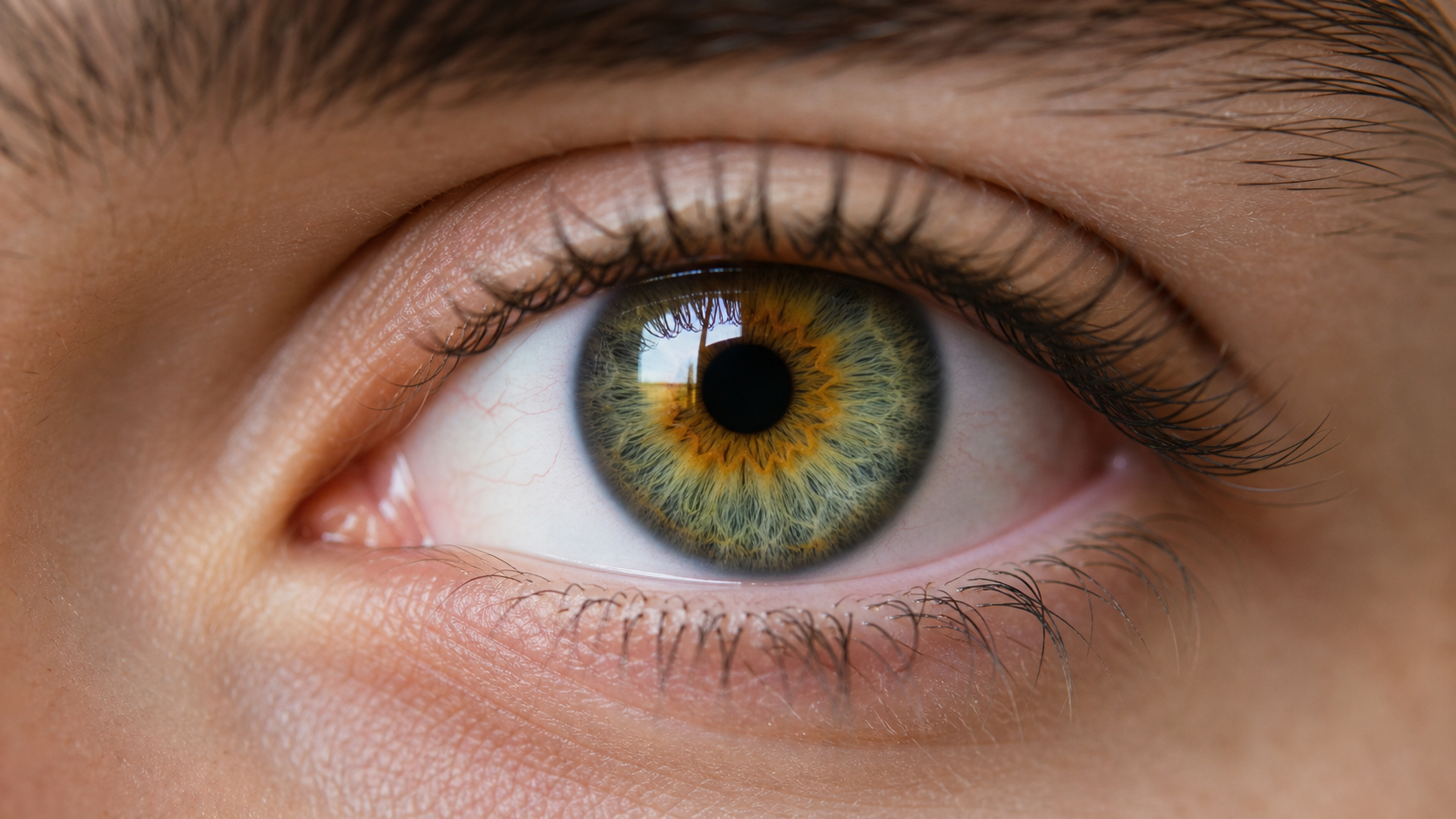
Green vs hazel eyes look similar at a glance, but they are not the same eye color. Green eyes usually appear more uniform across the iris, while hazel eyes tend to mix green, brown, and gold in a multi-toned pattern that can shift with light. If you are unsure where your eyes fit, the most reliable clues are iris pattern, central color concentration, and how the color changes from one part of the iris to another.
What is the difference between green vs hazel eyes?
The clearest difference between green vs hazel eyes is color distribution. Green eyes usually read as one dominant color across most of the iris. Hazel eyes usually contain at least two visible tones, most often green with brown, amber, or gold.
Green eyes are more uniform
Green eyes tend to show a more even wash of color. That color is created by relatively low melanin in the iris, combined with light scattering and the presence of yellowish pigment tones. Many green irises include subtle gray, olive, or golden notes, but the eye still reads primarily as green.
Hazel eyes are mixed by definition
Hazel eyes are usually defined by a blend, not a single shade. A hazel iris often has:
- a brown or amber ring near the pupil
- a greener outer iris
- visible flecks of gold or copper
- stronger color shifts in different lighting
That multi-toned structure is why hazel eyes are so often confused with green eyes. If the iris looks like one color from center to edge, it is more likely green. If it looks layered or patchy in a consistent way, it is more likely hazel.
Why people mix them up
Green and hazel sit close together visually. Both can include yellow-toned pigment and both can look warmer or cooler depending on light, clothing, and camera processing. That overlap is real, but the iris pattern still matters more than a casual glance.
For a color-family overview, see the green eyes guide and the hazel eyes guide.
How do pigment and iris structure create green and hazel eyes?
Eye color is not just paint in the iris. It comes from melanin amount, melanin type, iris structure, and how light scatters through the front layers of the eye.
The main pigments involved
The iris contains melanin, especially eumelanin and pheomelanin.
- Eumelanin is a darker brown-black pigment.
- Pheomelanin is a lighter red-yellow pigment.
Brown eyes have the most eumelanin overall. Green and hazel eyes have less eumelanin than brown eyes, but the distribution differs.
Why green eyes look green
Green eyes tend to have low to moderate melanin in the iris stroma. The green appearance comes from a combination of:
- small amounts of melanin
- yellowish pigment tones
- light scattering in the iris, similar to the Tyndall effect discussed with lighter eye colors
The result is an eye that appears green rather than blue or brown.
Why hazel eyes look mixed
Hazel eyes usually have uneven melanin distribution. Instead of one consistent pigment pattern, they often show concentrated brown or amber near the pupil and greener coloration farther out. That is why hazel often looks like a gradient rather than a flat color.
Research on eye color genetics often points to genes such as OCA2, HERC2, TYR, and SLC24A4 as contributors to iris pigmentation. These genes help regulate melanin production and distribution, but they do not work in a simple one-gene, one-color way. If you want the broader inheritance background, see Eye Color Genetics Explained: How Your DNA Determines Iris Color.
> Key fact: the difference between green vs hazel eyes is usually not one pigment versus another, but how much pigment is present, where it is concentrated, and whether the iris reads as uniform or mixed.
Are green eyes or hazel eyes rarer?
Green eyes are generally rarer than hazel eyes worldwide, based on commonly cited global estimates.
Global rarity by eye color family
Using the six eye color families used by Eye Color Identifier, approximate global rarity looks like this:
- Brown, about 79%
- Blue, about 8%
- Hazel, about 5%
- Amber, about 5%
- Green, about 2%
- Gray, about 1%
So if you are comparing green vs hazel eyes, green is usually the rarer category.
Why green eyes are less common
Green eyes require a narrower balance of pigment and structural effects. Too little melanin can push the appearance toward blue or gray. More melanin, especially if distributed unevenly, can push the appearance toward hazel or brown.
Why rarity does not always help identification
A rare color is not easier to spot. Many people assume their eyes are green because they notice green tones in sunlight, but if brown or amber is consistently present in the iris, hazel is often the better match. Rarity is useful context, not a diagnostic rule.
If you are comparing close shades, green vs hazel comparison guides can help clarify the edge cases.
Why do green and hazel eyes look different in sunlight, shade, and photos?
Lighting changes how all eye colors appear, but it especially affects green and hazel eyes because both rely on subtle pigment and scattering effects.
Sunlight tends to intensify contrast
In bright natural light, hazel eyes often reveal their separate zones more clearly. The brown or amber near the pupil may become more obvious, while the outer iris still reads green. Green eyes, by contrast, often become brighter and cleaner looking without showing the same level of central brown.
Shade can flatten the iris
In softer or dimmer conditions, both colors can appear darker. A green iris may look olive, gray-green, or muted forest green. Hazel may lose some of its contrast and look more uniformly brown-green, which is one reason people get confused.
Cameras often exaggerate the problem
Phone cameras adjust white balance, contrast, and saturation automatically. That can:
- make green eyes look more vivid than they are in person
- reduce the visible brown ring in hazel eyes
- create yellow highlights that suggest hazel even when the eye is green
- compress subtle texture differences
A single selfie is not always enough. Multiple photos in natural light usually tell a more accurate story.
For adjacent color confusion, blue vs green and blue vs gray show how lighting can shift perception across other iris families too.
What patterns in the iris help you tell green vs hazel eyes apart?
When people ask whether their eyes are green or hazel, the answer often comes down to pattern, not just hue.
Look at the center of the iris
Start near the pupil. If you see a consistent brown, amber, or golden ring that is clearly distinct from the outer iris, that points toward hazel. Green eyes can have a slightly warmer center, but they usually do not show a strong two-tone split.
Check the outer iris
A green eye often stays green through most of the iris, even if the exact shade varies. A hazel eye often transitions outward from brown or gold into green or olive.
Notice flecks versus overall color
Flecks alone do not define hazel. Many green eyes have small yellow or gold flecks. The question is whether those flecks dominate the iris pattern or whether the eye still reads mainly green.
Watch for a radial blend
Hazel eyes commonly show a sunburst effect, with warmer tones radiating from the pupil. Green eyes may show texture lines, but the overall color usually appears less segmented.
A quick self-check:
- If most people describe your eyes as green in ordinary light, and there is no clear brown center, green is likely.
- If people alternate between calling them green, brown, and gold, hazel is more likely.
- If the eye changes category depending on distance, inspect the center closely.
Can green eyes have brown or gold in them and still be green?
Yes. Green eyes can contain brown, gold, or yellow flecks and still be classified as green. The deciding factor is whether those warmer tones are accents or major structural features.
Flecks are common in many eye colors
Very few irises are perfectly flat in color. Texture, crypts, and pigment variation can create tiny contrasting marks. A green iris with sparse golden flecks is still usually green.
When mixed color becomes hazel
The label tends to shift toward hazel when the warmer tones are strong enough to shape the whole appearance of the iris. Common signs include:
- a distinct amber or brown ring around the pupil
- broad patches of brown mixed with green
- a visible green-to-brown gradient from outer to inner iris
Central heterochromia is a related issue
Some people have central heterochromia, where the ring around the pupil is a different color from the rest of the iris. That can resemble hazel, but it is not always the same thing. A green eye with central heterochromia can still be classified as green if the outer iris is clearly and dominantly green. A hazel eye usually looks mixed across the identity of the iris itself, not just as a sharply separated inner ring.
How does the Eye Color Identifier separate green vs hazel eyes?
Human judgment is subjective. One person sees green, another sees hazel, and a phone filter changes the result again. This is exactly where structured image analysis helps.
How the Eye Color Identifier helps
Eye Color Identifier analyzes iris photos using six eye color families, blue, green, hazel, brown, gray, and amber. For green vs hazel eyes, it looks at the dominant iris color, multi-tone distribution, and how much warm brown or golden pigment appears across the visible iris.
What it evaluates
The eye color identifier is useful because it does not rely on one quick impression. It helps separate:
- a mostly uniform green iris
- a green iris with minor gold flecks
- a clearly mixed hazel iris with green and brown zones
- edge cases that look different in bright and dim light
Why AI can help with borderline colors
Hazel is one of the most commonly misread categories because it sits between green and brown. The tool provides a consistent framework for looking at the full iris rather than focusing only on the brightest or most noticeable area.
Best results for green vs hazel analysis
For the strongest result when you identify your eye color, use:
- natural daylight, not harsh direct flash
- a sharp close-up where the iris fills enough of the frame
- minimal color filters or beauty adjustments
- both eyes if one photo is slightly shadowed
If you want a broader route before upload, the AI eye color test and what is my eye color page are useful starting points.
Why do people often think they have green eyes when they actually have hazel eyes?
This is very common, and there are a few predictable reasons.
Green sounds simpler than hazel
Many people use green as a shorthand for any eye that is not obviously blue or brown. But hazel is its own category, not just a less certain version of green.
The green part stands out first
In a hazel iris, the green outer area may be the easiest feature to notice from conversational distance. The brown or amber near the pupil becomes more obvious only up close.
Light favors the green tones
Sunlight and certain indoor lighting can make the green in hazel eyes appear stronger than the brown. That does not change the base classification.
Social descriptions are inconsistent
Friends may describe the same hazel eyes as green, golden, or brown depending on the setting. That inconsistency is a clue in itself. Truly green eyes tend to get described more consistently.
For another angle on tricky mixed shades, see further reading, which focuses on how AI maps multi-toned irises rather than this direct side-by-side comparison.
Do green or hazel eyes change over time?
They can appear to change, but true eye color changes in healthy adults are usually limited.
What can change
The appearance of green vs hazel eyes may shift because of:
- lighting conditions
- pupil size
- clothing color reflected near the eye
- camera white balance
- age-related subtle pigment changes
What usually does not change
Your underlying iris structure and melanin pattern do not swing dramatically from green to hazel day by day. If your eyes seem green in one mirror and hazel in another, it is usually because hazel contains multiple tones that become more or less visible depending on the setting.
When to pay medical attention
If one eye changes color suddenly, or if a section of the iris changes noticeably, an eye doctor should evaluate it. Cosmetic variation is common. Sudden biological change is a different issue.
What is the quickest at-home method to tell green vs hazel eyes apart?
You can make a decent first call at home if you check the iris systematically instead of casually.
A simple 4-step check
- Stand near a window with indirect daylight.
- Look closely at the iris center and outer ring.
- Take a sharp photo with no filter.
- Ask whether the iris reads as one main color or as a green-brown blend.
Signs that point to green
- the iris appears mostly green across the full surface
- warm flecks are small and scattered
- there is no dominant brown center
- the eye still reads green in neutral lighting
Signs that point to hazel
- the iris has an obvious brown, amber, or gold center
- green is strongest around the outer iris
- the color seems to switch between green and brown depending on distance
- multiple tones define the eye, not just decorate it
If you want a more objective read, use the eye color identifier with a daylight photo.
Frequently asked questions
Are hazel eyes just green eyes with brown in the middle?
Not exactly. Hazel eyes are usually classified by a meaningful mix of green, brown, amber, or gold across the iris pattern. Green eyes can have small warm flecks, but they still read primarily as green rather than mixed.
Which is rarer, green or hazel eyes?
Green eyes are rarer worldwide. Common estimates place green at about 2% globally and hazel at about 5%, though local populations can vary a lot.
Can the same eyes look green one day and hazel another day?
They can look different in different lighting, especially if they are hazel. The underlying eye color does not usually change quickly, but brightness, pupil size, and contrast can make green tones or brown tones stand out more on different days.
Is central heterochromia the same as hazel eyes?
No. Central heterochromia means a distinct inner ring around the pupil that differs from the outer iris. Hazel eyes are usually a broader mixed-color category, though some hazel eyes can also show central contrast.
What genes affect green vs hazel eyes?
Several genes influence these colors, including OCA2, HERC2, TYR, and SLC24A4. Research suggests that eye color is polygenic, so green vs hazel eyes result from multiple interacting factors rather than a single gene switch.
Can AI really tell green vs hazel eyes apart?
AI can help by analyzing the visible iris pattern more consistently than casual human judgment. It is especially useful for borderline cases where the eye appears green from far away but shows clear brown or amber zones up close.
Identify your eye color now
Still unsure about green vs hazel eyes? Upload a clear iris photo to Eye Color Identifier and get a structured result based on six eye color families. It is a quick way to check whether your eyes read as green, hazel, or another close match.
Try the Eye Color Identifier
Find your eye color in seconds. Your data is kept secure — we don't store your data.
More articles
Rare Eye Color Combinations: Heterochromia and More
Rare eye color combinations include heterochromia, central rings, and sectoral patterns. Learn how they form and how to classify them clearly.
Do Eyes Change Color? Babies, Light, and Real Changes
Do eyes change color? Learn when shifts are normal in babies, why hazel and lighting can mislead, and when eye color changes merit a check.
Eye Color Identifier: What Eye Color Am I, Really?
Eye color identifier guide: learn how AI answers “What eye color am I?”, why eyes get mislabeled, and what genetics can and cannot tell you.