Jul 6, 2026 · 12 min read
What Determines Eye Color? Pigment, Genes, and Light
What determines eye color? Learn how melanin, iris structure, and light scattering shape blue, green, hazel, brown, gray, and amber eyes.
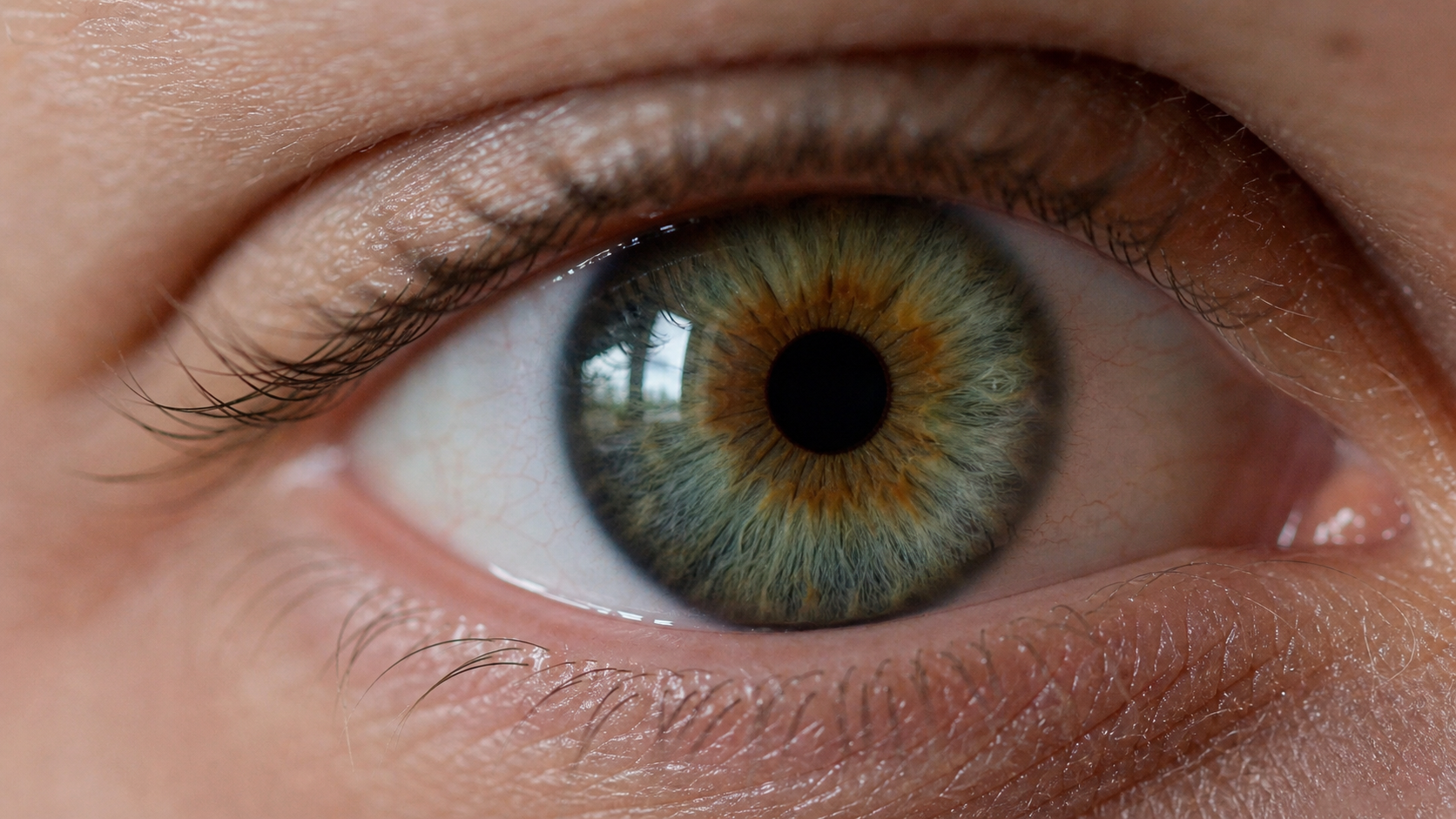
What determines eye color is mainly the amount and type of pigment in the iris, the way the iris tissue is built, and how light scatters through that tissue. Genes such as OCA2, HERC2, TYR, and SLC24A4 influence those traits, which is why eye color is inherited but not perfectly predictable. In simple terms, more brown pigment usually means darker eyes, while less pigment plus light scattering can make eyes look blue, gray, or green.
What determines eye color in the iris?
Your iris is the colored ring around the pupil. Its appearance comes from three things working together, not from pigment alone.
Pigment amount
The biggest factor is melanin. This is the same broad pigment family involved in skin and hair color. In the iris, higher melanin concentration tends to produce darker eye colors, especially brown. Lower melanin allows more light interaction with the iris tissue, which is why lighter eyes appear.
Two pigment forms matter in eye color discussions:
- Eumelanin is a dark brown to black pigment. More eumelanin usually means deeper brown eyes.
- Pheomelanin is a reddish to yellow pigment. Smaller amounts of pheomelanin can contribute to warmer tones, especially in amber and some hazel eyes.
Iris stroma structure
The front layer of the iris, often discussed as the stroma, affects how light moves through the tissue. It contains fibers, cells, and spacing patterns that influence reflection and scattering. Two people can have similar pigment levels but slightly different iris textures, which can shift the way their eye color appears in photos or daylight.
Light scattering
Lighter eyes are not blue or gray because the iris contains blue or gray dye. Instead, much of that appearance comes from light scattering, often compared to the Tyndall effect. Shorter wavelengths of light scatter in a way that can make a low-melanin iris look blue, gray, or blue-gray.
> Eye color is not just a paint color stored in the iris. It is the visible result of pigment, tissue structure, and light interacting at the same time.
That is the short answer to what determines eye color. The longer answer is that each eye color family reflects a different balance of those same ingredients.
How do melanin, eumelanin, and pheomelanin change eye color?
When people ask what determines eye color, they are often really asking how pigment creates visible differences between brown, amber, hazel, green, blue, and gray eyes.
Brown eyes
Brown eyes usually have the highest melanin content overall, especially eumelanin. That heavy pigment load absorbs more incoming light, so less scattering is visible. This is why brown is the most common eye color worldwide, at about 79% of the global population.
If you want to compare shades within this category, see the brown eye color guide.
Amber eyes
Amber eyes tend to show a more golden, copper, or honey appearance. They are often linked to a distinct balance of lower dark eumelanin with more visible warm-toned pigment, including pheomelanin. Amber is rare, estimated at around 5% globally.
For a deeper look at this color family, visit the amber eye color guide.
Hazel eyes
Hazel eyes often combine brown, gold, and green in the same iris. This happens because pigment is unevenly distributed, often with more melanin near the pupil and less toward the outer iris. Light scattering across those mixed zones can make hazel eyes seem to shift between green, brown, and gold depending on distance and lighting.
Hazel is also estimated at about 5% globally. For more on the mixed-color pattern itself, see further reading.
Green eyes
Green eyes usually have relatively low melanin overall, but still more pigment than typical blue eyes. A mix of mild melanin presence, yellowish pigment contribution, and light scattering can create a green appearance. Green eyes are rare, at roughly 2% worldwide.
You can compare examples in the green eye color guide.
Blue eyes
Blue eyes usually have low melanin in the front layers of the iris. Because there is less pigment to absorb light, scattering becomes much more visible. This is why blue eyes are not blue from blue pigment, but from optical effects interacting with low pigment levels. Blue eyes occur in about 8% of the global population.
See the blue eye color guide for common shade variations.
Gray eyes
Gray eyes are even rarer, around 1% globally. They are often thought to involve very low pigment plus a stromal structure that scatters light in a more muted, neutral-looking way than blue eyes. Some gray irises also appear to have more collagen density or different light diffusion patterns, though the visible distinction can be subtle.
If you are trying to tell these apart, this gray vs blue article covers the comparison angle.
Which genes determine eye color?
Genes matter because they help control how much pigment your iris makes, how pigment is processed, and how that color is expressed in tissue. Eye color is not controlled by one simple dominant gene pair. It is polygenic, meaning multiple genes contribute.
OCA2
OCA2 is one of the best-known genes linked to eye color variation. It plays a major role in melanin production and regulation. Variants in or near OCA2 can influence whether the iris develops more or less pigment.
HERC2
HERC2 is famous because a regulatory region within it helps control OCA2 activity. One common variant in HERC2 is strongly associated with blue versus brown eye color in many European populations. In simple terms, HERC2 can affect how much OCA2 gets expressed, which then affects melanin in the iris.
TYR
TYR, short for tyrosinase, is involved in melanin synthesis. Since melanin production depends on enzymes, TYR matters to the pigment pathway. Variants here can shift overall pigment behavior, although TYR alone does not fully explain a person’s final eye color.
SLC24A4
SLC24A4 has also been associated with normal variation in pigmentation, including eye color. Research suggests it plays a role in pigment biology and can contribute to lighter or darker appearance when combined with other genetic factors.
Why no single gene can explain everything
Several other genes also contribute, and their effects combine. That is why two brown-eyed parents can sometimes have a blue-eyed child, and why siblings often show different shades of hazel, green, or gray. If you want the broader inheritance overview, eye color genetics explained covers that topic in full.
Why are some eye colors rare?
Rarity comes down to genetics, ancestry patterns, and how many conditions must line up for a certain color to appear.
Brown is common because high melanin is common
Brown eyes are the global majority, at about 79%. That makes sense biologically because strong melanin expression in the iris is widespread across human populations.
Lighter eyes need a narrower combination
Blue, green, and gray eyes often require lower melanin levels and particular gene combinations. They are not random. They are simply less common outcomes in the full range of human inheritance.
Mixed eyes are harder to classify
Hazel and amber are both estimated at around 5% worldwide, but they are often undercounted or mislabeled in casual descriptions. A person may call their eyes brown indoors, green outdoors, and hazel in bright portraits. That does not mean the eye color changes. It means human classification is imperfect.
Here is the commonly cited global distribution used by Eye Color Identifier:
- Brown, about 79%
- Blue, about 8%
- Hazel, about 5%
- Amber, about 5%
- Green, about 2%
- Gray, about 1%
Those percentages are useful for context, but individual populations can look very different from the global average.
Why do eye colors look different in sunlight, shade, and photos?
A lot of confusion about what determines eye color comes from the fact that the same eyes can look different from one setting to the next.
Lighting changes perceived color
Bright natural light reveals texture, central rings, and flecks that indoor lighting hides. Hazel eyes often look greener outside. Gray eyes may look blue under cool daylight. Brown eyes can look lighter in direct sun because more texture becomes visible.
Camera processing changes color
Phone cameras often increase contrast, saturation, and sharpness. That can make amber tones look more orange, blue eyes more vivid, and gray eyes more icy than they appear in person.
Clothing and surroundings matter
Reflected color from makeup, shirts, or nearby surfaces can subtly influence the tones you notice. This does not alter the iris itself, but it can change what your brain perceives.
Pupil size changes what you see
When the pupil gets larger or smaller, it can expose different amounts of the iris pattern. In mixed eyes such as hazel, that sometimes makes one color ring seem more dominant.
If your eyes seem to shift between two shades, a side-by-side comparison can help. For example, blue vs green eye differences often come down to undertone, saturation, and visible yellow-brown pigment near the pupil.
Can eye color change over time?
The basic answer is yes, but usually only within limits. Most natural eye color shifts happen in infancy or as a result of lighting, aging, health, or medication, not because the iris suddenly becomes a completely different genetic color.
Newborn and infant changes
Many babies are born with lighter-looking eyes because melanin production is still developing. Over the first months or years, the iris may darken as pigment increases. This is one reason inherited eye color can take time to fully show.
Age-related changes
Some people notice small changes over time. Eyes may appear less vivid with age because of changes in the iris, cornea, or lens. Gray or hazy appearance can sometimes reflect aging of the eye rather than a true change in iris pigment.
Medical causes
Certain medical conditions, injuries, and medications can alter eye appearance. Sudden or one-sided color change should be discussed with an eye care professional.
What usually does not change
Your genetic tendency for iris pigment and structure remains the foundation. A person with blue eyes may look blue-gray in winter light and bright blue in summer sun, but the underlying eye color system has not been rewritten.
How can you tell your true eye color?
This is where science and perception meet. People often struggle because they are trying to choose one label for an iris that contains several visible tones.
Look at the iris, not the mood of the photo
The best way to judge eye color is to inspect the iris pattern itself. Ignore filters, warm indoor bulbs, and edited selfies. Use neutral daylight when possible.
Focus on the dominant color family
Eye Color Identifier uses six eye color families:
- Blue
- Green
- Hazel
- Brown
- Gray
- Amber
The right label is usually the family that dominates most of the iris, not every minor fleck or ring.
Check for these visual clues
- Brown tends to look uniform or deep throughout most of the iris.
- Amber tends to look golden, honey-like, or copper-toned without clear green zones.
- Hazel often shows a visible mix, commonly green with brown or gold near the pupil.
- Green tends to read primarily green across the iris, even if gold flecks are present.
- Blue usually has a cool, low-pigment look with no strong brown overlay.
- Gray tends to appear more neutral, smoky, or silvery than blue.
Compare edge cases carefully
If you are deciding between categories that often get confused, use a comparison page rather than guessing from memory. For example, green vs hazel is a common problem because both can include yellow or gold elements.
How the Eye Color Identifier helps
If you are still unsure what determines eye color in your specific case, the practical issue is usually classification, not biology. Real irises are textured, multi-toned, and sensitive to lighting, which makes self-labeling harder than it sounds.
The Eye Color Identifier analyzes an uploaded eye photo and sorts it into one of six eye color families: blue, green, hazel, brown, gray, or amber. It is useful when your iris seems to shift between categories, especially in cases like blue-gray, green-hazel, or amber-brown. Photos and data are kept secure, and photos are not stored.
If you want a broader starting point before uploading a photo, you can also try the eye color test or browse what is my eye color for more examples.
What are the biggest myths about what determines eye color?
Eye color attracts a lot of oversimplified advice. Some of it is harmless. Some of it leads people to misidentify their eyes.
Myth: Eye color is controlled by one gene
This is one of the most persistent myths. In reality, eye color is influenced by multiple genes, including OCA2, HERC2, TYR, and SLC24A4, among others.
Myth: Blue eyes contain blue pigment
They usually do not. Blue appearance mostly comes from low melanin plus light scattering through the iris stroma.
Myth: Hazel eyes always change color
Hazel eyes often look different in different settings, but that is usually a perception issue caused by lighting and mixed pigment zones. The iris pattern itself is stable.
Myth: Personality is determined by eye color
There are many cultural associations around blue, green, brown, or gray eyes, but personality traits are not scientifically determined by iris color. At most, these are social stereotypes or aesthetic impressions.
Myth: One photo is enough to classify every eye correctly
Not always. Angle, flash, shadows, and editing can all distort appearance. A close, well-lit image works better than a distant portrait.
Frequently asked questions
What determines eye color the most?
The biggest factor in what determines eye color is melanin in the iris, especially how much pigment is present. Iris structure and light scattering also matter, which is why low-pigment eyes can appear blue or gray instead of simply lighter brown.
Is eye color determined only by genetics?
Genetics is the main reason your iris develops a certain pigment pattern, but it is not the only visible factor. What determines eye color in practice also includes the iris stroma and the way light scatters through it.
Do OCA2 and HERC2 determine eye color by themselves?
No. OCA2 and HERC2 are major contributors, especially in studies of blue and brown eye variation, but they do not explain every shade on their own. TYR, SLC24A4, and other genes also help determine eye color.
Why do my eyes look green sometimes and brown other times?
This is common with hazel or mixed irises. Uneven pigment distribution plus changing light can shift which tones stand out most, even though your actual eye color category stays the same.
Are gray eyes just light blue eyes?
Sometimes they are close, but not always. Gray eyes tend to look more neutral or silvery, and the stromal structure may scatter light differently than in blue eyes. If you are unsure, compare examples in the gray eye color guide.
Can diet or mood determine eye color?
Diet and mood do not determine eye color in the genetic sense. They may affect your overall appearance or the way your eyes look in certain lighting, but they do not change the iris pigment system that defines natural eye color.
Identify your eye color now
If you know what determines eye color but still cannot decide which label fits your iris, use the eye color identifier to check a close-up photo. It can help sort mixed, light-sensitive, and hard-to-classify eyes into the six main eye color families with a clearer, more consistent result.
Try the Eye Color Identifier
Find your eye color in seconds. Your data is kept secure — we don't store your data.
More articles
Rare Eye Color Combinations: Heterochromia and More
Rare eye color combinations include heterochromia, central rings, and sectoral patterns. Learn how they form and how to classify them clearly.
Do Eyes Change Color? Babies, Light, and Real Changes
Do eyes change color? Learn when shifts are normal in babies, why hazel and lighting can mislead, and when eye color changes merit a check.
Eye Color Identifier: What Eye Color Am I, Really?
Eye color identifier guide: learn how AI answers “What eye color am I?”, why eyes get mislabeled, and what genetics can and cannot tell you.