Jul 14, 2026 · 12 min read
Two Different Colored Eyes Explained: Heterochromia Types
Two different colored eyes can result from heterochromia. Learn the types, causes, rarity, and when color changes need a doctor visit.
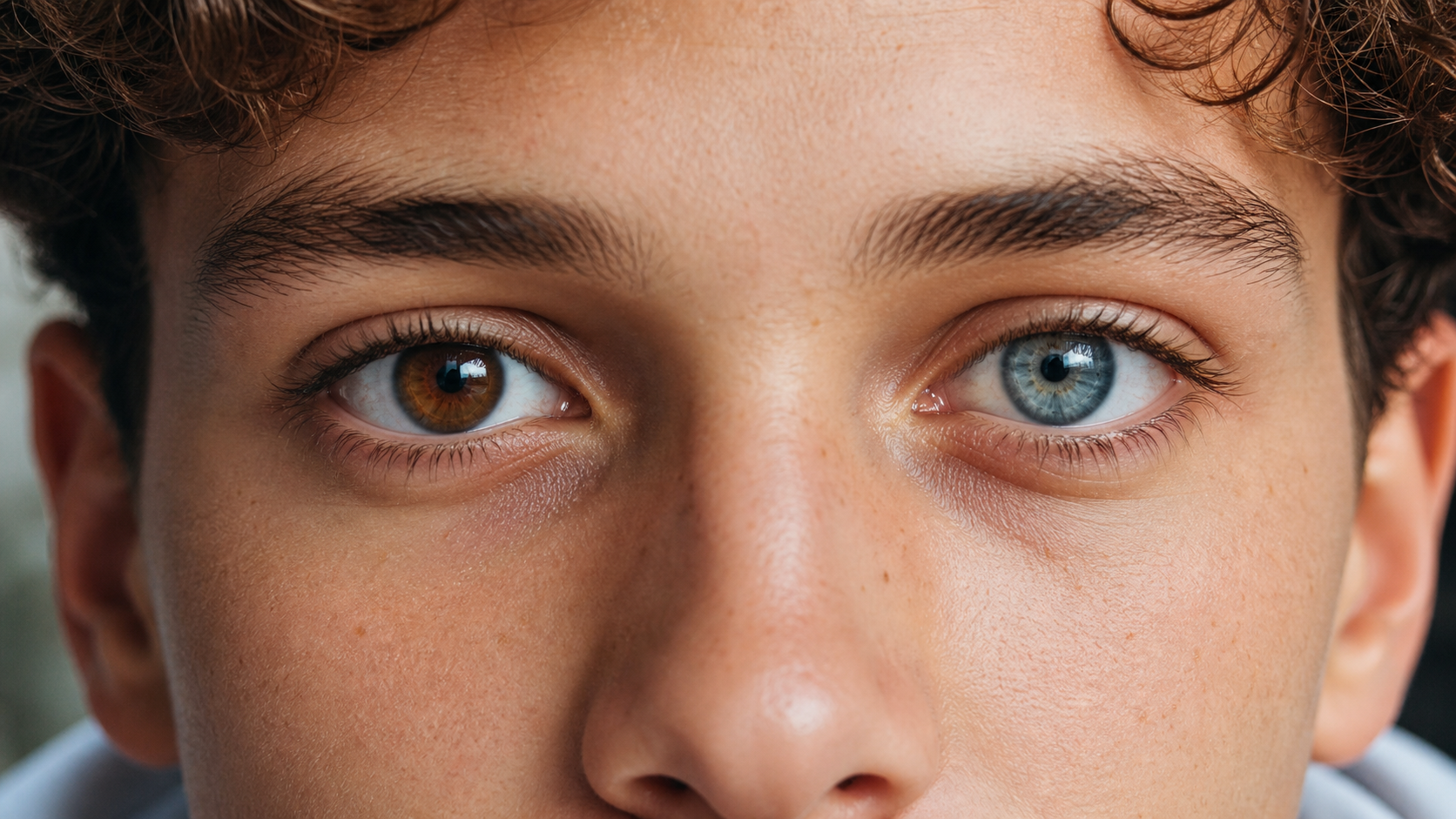
Two different colored eyes usually mean heterochromia, a difference in iris color caused by how melanin is distributed in one eye, between both eyes, or within part of the same iris. In many people, heterochromia is present from birth and harmless. But if two different colored eyes appear suddenly, especially with pain, vision changes, or after an injury, it is worth a prompt eye exam.
What does it mean to have two different colored eyes?
Two different colored eyes is the everyday phrase for heterochromia iridum or heterochromia iridis. The term covers more than one pattern. Some people have one blue eye and one brown eye. Others have a ring of one color around the pupil and another color around the outer iris. Some have only one wedge-shaped segment that differs from the rest of the eye.
The basic reason is simple. Iris color depends on the amount and distribution of melanin, especially eumelanin and, to a lesser extent, pheomelanin, plus how light scatters through the iris. Brown eyes have more melanin. Blue eyes have much less melanin and appear blue partly because of light scattering, often described through the Tyndall effect. Gray, green, hazel, and amber sit between those extremes in different ways.
Eye color overall is strongly influenced by genes including OCA2 and HERC2, with other genes such as TYR and SLC24A4 also contributing. If you want the broader genetics background, see eye color genetics explained and what determines eye color.
> Most heterochromia is benign and simply reflects how pigment developed in the iris. A new or rapidly changing difference in eye color is the part that deserves medical attention.
What are the three types of heterochromia?
Doctors and eye color specialists usually divide heterochromia into three main types: complete, central, and sectoral. Knowing which kind you have matters, because each pattern can look very different in photos.
Complete heterochromia
Complete heterochromia means each iris is a different overall color. Classic examples include:
- one brown eye and one blue eye
- one green eye and one brown eye
- one gray eye and one blue eye
This is the version most people picture when they hear "two different colored eyes." It is visually striking because the entire left and right irises belong to different color families.
Central heterochromia
Central heterochromia means there is a distinct inner ring of color around the pupil that differs from the outer iris. For example, an eye may have a golden or amber center with a green or blue outer area. This can happen in both eyes symmetrically, or one eye may show it more strongly than the other.
Central heterochromia is often mistaken for hazel eyes, because hazel eyes are also multi-toned. The difference is pattern. Central heterochromia tends to form a clearer inner ring, while hazel often appears more blended and variable under different lighting. For deeper comparison, see green vs hazel and our hazel eyes guide.
Sectoral heterochromia
Sectoral heterochromia, also called partial heterochromia, means one section of the iris differs in color from the rest. It may look like a pie-slice, wedge, or patch. A brown iris might contain one blue-gray segment, or a blue iris might have one brown segment.
Sectoral heterochromia can be subtle in normal indoor lighting and much more obvious in bright natural light. It is also the pattern most likely to be missed in casual selfies if there is glare on the cornea.
How rare are two different colored eyes?
Two different colored eyes are uncommon, but not vanishingly rare. Precise global numbers are hard to pin down because studies use different definitions, especially for central heterochromia. Most estimates suggest true heterochromia affects well under 1 percent of people worldwide.
That rarity makes sense when you compare it with general eye color prevalence:
- Brown eyes: about 79%
- Blue eyes: about 8%
- Hazel eyes: about 5%
- Amber eyes: about 5%
- Green eyes: about 2%
- Gray eyes: about 1%
A person with complete heterochromia combines two different outcomes in one face, which is why it stands out so strongly. People with sectoral or central heterochromia may be more common than complete heterochromia, but they are also more often mislabeled as simply hazel, green, or blue-eyed.
Why heterochromia seems more common online than in real life
Photos on social platforms often exaggerate eye color through contrast, color grading, ring lights, or cosmetic contact lenses. Some people who appear to have two different colored eyes in edited images actually have:
- central heterochromia rather than complete heterochromia
- asymmetrical lighting between eyes
- one dilated pupil changing the visible iris area
- different reflections masking one iris color
- colored lenses
That is one reason image-based assessment works best with sharp, neutral-light photos.
What causes heterochromia, and is it genetic?
Heterochromia can be congenital, meaning present from birth or early infancy, or acquired, meaning it develops later. The cause determines whether it is usually harmless or worth medical follow-up.
Congenital causes
Congenital heterochromia is often benign. It can happen when pigment is distributed differently as the iris develops. The same genes that influence general eye color, including OCA2, HERC2, TYR, and SLC24A4, can be part of that story, even when the final result is asymmetrical.
Some people inherit heterochromia as a normal family trait. In others, it appears without a clear family pattern. Rarely, congenital heterochromia can be associated with genetic or developmental syndromes, which is why pediatric eye exams matter when a baby has other unusual signs.
Acquired causes
Acquired heterochromia happens after the iris has already developed. Possible causes include:
- Eye injury or trauma, which can alter pigment or damage the iris.
- Inflammation, such as some forms of uveitis.
- Certain glaucoma medications, especially prostaglandin analog drops, which may darken the iris over time.
- Bleeding or deposits in the eye, which can change visible color.
- Tumors or growths involving the iris, though these are much less common.
- Surgery or other procedures affecting the eye.
The key distinction is timing. A lifelong stable difference in eye color is often normal. A new difference that appears over weeks or months needs a clinician to determine why.
Can illness change just one eye color?
Yes. Illness can affect one eye more than the other. That is why new unilateral color change matters more than the exact shade itself. If one eye becomes darker, lighter, or develops a new patch of color, especially with redness, light sensitivity, drooping eyelid, headache, or blurry vision, a medical exam is the right next step.
When are two different colored eyes normal, and when should you see a doctor?
This is the most practical question for most readers. Many forms of heterochromia are simply a normal pigment variation. Others can signal an underlying issue.
Usually normal
Heterochromia is more likely to be harmless when:
- it has been present since birth or early childhood
- the color pattern has stayed stable over time
- there is no pain, redness, or visual change
- both pupils look normal
- there is no recent injury or eye surgery
A person with stable complete or sectoral heterochromia and normal vision often just has a distinctive iris pattern.
Worth a doctor visit
You should book an eye exam if you notice:
- a new difference between the eyes
- one iris becoming steadily darker or lighter
- a new brown, gray, or white patch in the iris
- pain, redness, or sensitivity to light
- blurred vision, floaters, or reduced vision
- a recent eye injury
- drooping eyelid or a change in pupil size
Emergency vs routine timing
If the color change happens along with sudden pain, major vision change, severe headache, or trauma, treat it as urgent. If it is a long-standing difference with no symptoms, it is usually a routine discussion at your next eye appointment.
How do complete, central, and sectoral heterochromia look in real life?
Descriptions help, but people often want visual cues they can compare in a mirror or photo. The challenge is that lighting changes perception. Warm indoor bulbs can make a green center look amber. Bright daylight can make a gray outer iris look blue.
Complete heterochromia visual signs
Complete heterochromia tends to be easiest to spot without magnification. Common pairings include:
- brown and blue
- brown and green
- blue and gray
The border between colors is simple because each whole iris reads as a different family. If you are unsure whether one eye is blue or gray, blue eyes and gray eyes can be hard to separate under cool light.
Central heterochromia visual signs
Look for an inner ring around the pupil that is clearly warmer or darker than the outer iris. Common examples:
- amber center with green outer iris
- gold center with blue outer iris
- brownish center with gray-green outer iris
This is why central heterochromia gets confused with hazel. If the iris appears mostly blended rather than ringed, compare with hazel eyes.
Sectoral heterochromia visual signs
Sectoral heterochromia often appears as one sharply bounded segment. It may occupy a small slice or nearly half the iris. In photos, it can disappear if the segment is hidden by shadow, eyelashes, or a catchlight.
Why mirrors and selfies can mislead you
A mirror gives a limited view because you rarely examine the iris under consistent magnification and light. Phone cameras introduce extra problems:
- automatic white balance shifts color temperature
- HDR processing changes contrast
- beauty filters smooth iris details
- low resolution blurs sector boundaries
- glare covers part of the iris
If you want a more structured result, an AI eye color test or what is my eye color tool works best with a close, sharp image taken in soft natural light.
Can eye color change over time if you have heterochromia?
Sometimes, yes. But the reason matters.
Normal developmental changes
Babies can be born with lighter eyes that darken over the first months or years as melanin production changes. That does not always mean heterochromia, but it can make one eye or one iris area look different temporarily before pigment stabilizes.
Stable adult heterochromia
In most adults with congenital heterochromia, the pattern remains fairly stable. The color may appear slightly different across seasons, lighting environments, or pupil size, but the underlying pattern does not usually change dramatically.
Changes that should not be ignored
Adults who notice a meaningful new color shift should not assume it is cosmetic or age-related. A gradual darkening in one iris, a new segment, or a sudden contrast between eyes can reflect medication effects, inflammation, injury, or another eye condition.
If your question is less about heterochromia and more about subtle shifts between cool-toned eyes, our gray vs blue explanation is useful further reading.
How does the Eye Color Identifier handle each eye separately?
This topic matters because people with two different colored eyes are often mislabeled by generic image tools. A good eye color analysis should not force both eyes into a single category if the irises are clearly different.
The Eye Color Identifier is designed around six eye color families: blue, green, hazel, brown, gray, and amber. For someone with heterochromia, the important part is that each eye can be assessed separately, rather than averaging both irises into one result.
Why separate-eye analysis matters
If one eye is brown and the other is blue, combining them into one label would be inaccurate. The same is true for subtler cases:
- one eye may be green with amber central heterochromia
- the other may be hazel overall
- one eye may contain a sectoral brown patch in an otherwise gray iris
Looking at each iris separately reduces the chance that one eye dominates the classification.
How to photograph heterochromia for better results
For the best read on two different colored eyes, use this process:
- Stand in soft natural light, near a window or outdoors in shade.
- Avoid direct sun, heavy shadows, and ring-light glare.
- Keep both eyes open and facing the camera evenly.
- Use a sharp, high-resolution photo with the irises clearly visible.
- Remove colored contact lenses.
- If one eye has a sectoral patch, take a second close-up so the segment is visible.
What the tool can and cannot do
The Eye Color Identifier can help classify visible iris color patterns from a photo. It is useful when you are unsure whether an eye reads as blue, gray, green, hazel, amber, or brown, especially when heterochromia makes one side different from the other.
It is not a medical diagnostic tool. If one eye has changed color recently, or you have symptoms such as pain or vision loss, use the tool for description, not for deciding whether a health issue is present.
Photos and data are kept secure. We do not store photos.
Why is heterochromia often confused with hazel, amber, blue, or gray eyes?
Many people do not actually have two different colored eyes in the complete heterochromia sense. They have a mixed iris pattern that sits near the borders between recognized eye color families.
Hazel vs central heterochromia
This is the most common mix-up. Hazel often combines green, brown, and gold tones in a blended pattern. Central heterochromia tends to create a more defined inner ring. If your eye looks green from a distance but shows a copper ring up close, either interpretation may seem plausible depending on lighting and photo quality.
For side-by-side help, compare green eyes with hazel eyes, or use green vs hazel.
Amber vs light brown
Amber eyes are often described as golden, coppery, or honey-colored and are rare, around 5% globally by the product's working distribution. A brown eye with strong warm highlights can be mistaken for amber, especially in sunlight. That distinction matters in central heterochromia, where only the inner ring may be amber.
Blue vs gray
Low-melanin eyes can look blue one day and gray the next depending on environment, clothing color, cloud cover, and camera processing. This gets even harder when one eye is cool blue and the other is cool gray, or when one iris contains a gray segment.
Brown patches in an otherwise light iris
Sectoral heterochromia can look like a flaw in the photo rather than a real pigment difference. Small brown wedges in blue or green irises are easy to miss unless the image is crisp.
Are there cultural meanings attached to two different colored eyes?
Yes, but they should be treated as cultural stories, not science. Across cultures, two different colored eyes have been associated with rarity, mystery, intuition, unusual beauty, or even supernatural traits. Those ideas are interesting socially, but they do not say anything reliable about personality or health.
Research does support the idea that unusual appearance traits can affect how people are perceived by others. It does not support claims that heterochromia predicts character, intelligence, or behavior. If someone says people with two different colored eyes are inherently more creative or more intense, that is cultural symbolism, not medical fact.
Frequently asked questions
Are two different colored eyes inherited?
Sometimes. Two different colored eyes can be congenital and influenced by the same pigment-related genes that shape overall iris color, including OCA2 and HERC2. But not every case follows a simple family pattern, and some heterochromia is acquired later in life.
Is central heterochromia the same as hazel eyes?
No. Central heterochromia usually refers to a distinct inner ring of a different color around the pupil, while hazel eyes tend to show a more blended mix of green, gold, and brown. In practice, the two are often confused, especially in photos with poor lighting.
Can two different colored eyes develop later in life?
Yes. If two different colored eyes appear later, that is called acquired heterochromia. Possible causes include injury, inflammation, medications, surgery, or other eye conditions, which is why a new change deserves an eye exam.
Is heterochromia dangerous?
Usually not, if it has been present for years and you have no symptoms. Heterochromia becomes more concerning when the eye color difference is new or changing, or when it comes with pain, redness, light sensitivity, or vision changes.
Can an AI tool identify heterochromia accurately?
An AI tool can help describe visible iris color patterns, especially when each eye is assessed separately. The eye color identifier is most useful for classifying eye color families from a clear photo, but it does not replace an eye doctor when a color change may reflect a medical issue.
What is the rarest type of heterochromia?
Complete heterochromia is often considered the rarest and most visually obvious type, because each iris belongs to a different color family. Sectoral and central heterochromia may be somewhat more common, but they are also more likely to be overlooked or mislabeled.
Identify your eye color now
If you have two different colored eyes, central heterochromia, or a sectoral patch that is hard to label, try identify your eye color with a sharp photo in natural light. The Eye Color Identifier can assess each iris more clearly than a casual mirror check, which helps when one eye does not match the other.
Try the Eye Color Identifier
Find your eye color in seconds. Your data is kept secure — we don't store your data.
More articles
Rare Eye Color Combinations: Heterochromia and More
Rare eye color combinations include heterochromia, central rings, and sectoral patterns. Learn how they form and how to classify them clearly.
Do Eyes Change Color? Babies, Light, and Real Changes
Do eyes change color? Learn when shifts are normal in babies, why hazel and lighting can mislead, and when eye color changes merit a check.
Eye Color Identifier: What Eye Color Am I, Really?
Eye color identifier guide: learn how AI answers “What eye color am I?”, why eyes get mislabeled, and what genetics can and cannot tell you.